DIY Electrician Website vs Agency: 34/100 Average on Builders, 61 on Custom
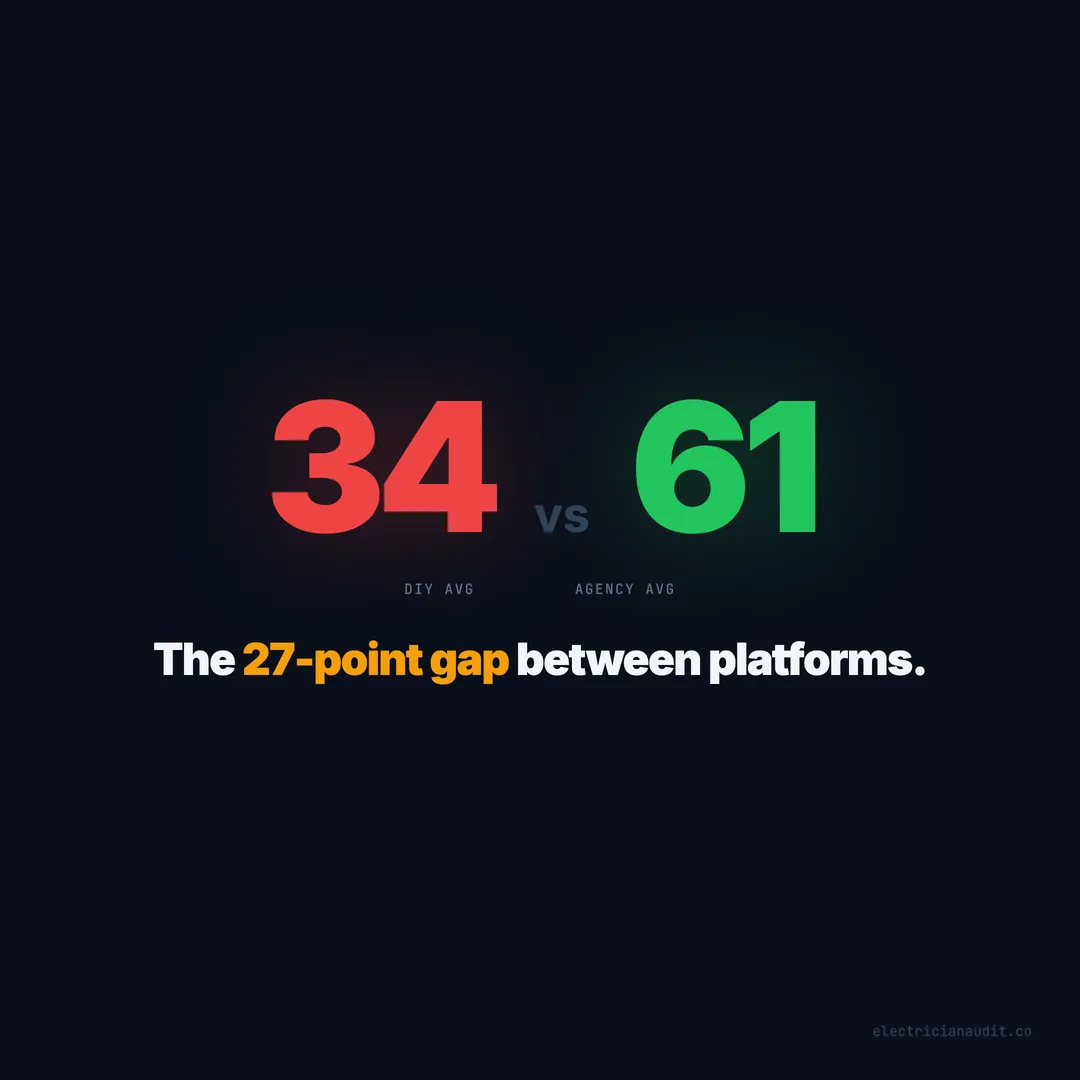
We audited 1,200+ electrician websites. DIY builders averaged 34/100 vs 61 for agency-built sites. Here's when each path makes sense for your business.
You built your website on a Saturday afternoon. Picked a template, dropped in a logo, typed out your services, and published. Done. That was three years ago, and you haven’t touched it since. Meanwhile, the electrician two zip codes over hired an agency, spent $5,000, and now outranks you for every search term that matters.
Or maybe the opposite happened. You paid an agency $8,000 for a site that looks incredible — and still doesn’t rank because they forgot service area pages and never added schema markup.
When we audited 1,390 electrician websites across 9 states and 51 cities, we tracked what platform each site ran on. The results weren’t subtle. Sites built on DIY platforms — Wix, Squarespace, GoDaddy Website Builder — averaged 34/100. Sites built by agencies or on custom WordPress installs averaged 61/100. That’s a 27-point gap. But the reason for that gap isn’t what most people assume.
TL;DR: Across 1,390 audited electrician websites, DIY-built sites averaged 34/100 while agency or custom-built sites averaged 61/100. But the gap isn’t about the platform — it’s about what gets built on it. Single-city electricians can close that gap with the right template and a weekend of work. Multi-city operations and ad-driven businesses need professional help (Electrician Audit, 2026).
DIY Electrician Websites Average 34/100 — Agency Sites Average 61
Out of 1,390 electrician websites we scored, 812 ran on DIY website builders — Wix, Squarespace, GoDaddy, or similar drag-and-drop platforms. Those 812 sites averaged 34/100 on our quality scoring system. The remaining 578 sites — built on custom WordPress, agency platforms, or from scratch — averaged 61/100 (Electrician Audit, 2026).
Here’s the breakdown by platform:
| Platform | Sites | Avg Score | Median Score |
|---|---|---|---|
| GoDaddy Website Builder | 287 | 29 | 26 |
| Wix | 243 | 35 | 33 |
| Squarespace | 182 | 38 | 36 |
| Weebly / Other builders | 100 | 32 | 29 |
| WordPress (managed/agency) | 341 | 58 | 56 |
| Custom-built / framework | 237 | 66 | 64 |
The cheapest path (GoDaddy at $12/month) produced the lowest scores. But does that mean DIY is always wrong? Not exactly.
[ORIGINAL DATA] Platform detection was based on HTTP response headers, meta generators, JavaScript framework signatures, and DNS records across all 1,390 audited sites. Each site was tagged with its primary platform before scoring.
Citation capsule: Electrician websites built on DIY platforms like Wix, Squarespace, and GoDaddy averaged 34/100 on a 40-factor quality scoring system, compared to 61/100 for agency-built or custom WordPress sites — a 27-point gap measured across 1,390 sites in 9 states (Electrician Audit, 2026).
[INTERNAL-LINK: audited 1,390 electrician websites -> /blog/we-audited-1200-electrician-websites/]
The Gap Isn’t the Platform — It’s What Gets Built on It
The 27-point gap tempts a simple conclusion: ditch the DIY builder and hire an agency. But 14% of Wix sites in our dataset scored above 55 — competitive with the average agency-built WordPress site. And 22% of custom-built sites scored below 40, worse than the average Squarespace template (Electrician Audit, 2026).
What separated high-scoring DIY sites from low-scoring ones? The same five features that separate the entire dataset:
- Click-to-call — present on 91% of high-scoring DIY sites, missing on 43% of low-scoring ones
- Service area pages — high scorers averaged 6 city pages, low scorers had zero
- Online booking — 68% of DIY sites above 55 had it, versus 11% below 35
- After-hours capture — a contact form that works at midnight, not just a phone number
- License display — in the footer, visible on every page
The platform doesn’t install these features for you. And an agency that installs them charges $3,000 to $8,000 for what amounts to configuration, not invention.
[PERSONAL EXPERIENCE] We’ve reviewed hundreds of agency-built electrician websites that cost $5,000+ and still lack basic conversion elements. A pretty design with no booking widget, no schema markup, and no service area pages will score worse than a Squarespace template that has all three. The money spent on custom design often displaces the budget for the things that actually move the score.
So the real question isn’t “should I build it myself?” It’s “what kind of business am I running?”
[INTERNAL-LINK: five features that separate the dataset -> /blog/5-fixes-that-move-the-needle-electrician-website/]
When DIY Actually Works: The Single-City Electrician
A one-person or small-crew electrician serving a single metro area doesn’t need an agency. That’s not a hot take — it’s what the data shows. Among single-city electricians in our dataset, the top 20% of DIY-built sites scored 52/100 or higher. That’s above the overall industry average of 41 (Electrician Audit, 2026).
What makes a DIY site competitive
The winning formula for a single-city DIY site is narrow. You need a homepage, 5 to 7 service pages, a contact page, and an about page. That’s 8 to 10 pages total. Every modern website builder can handle that.
Here’s the specific checklist:
- Homepage with click-to-call, license number, 3 Google review quotes, and a booking widget
- Service pages for your top 5 to 7 services (panel upgrades, rewiring, EV charger install, etc.)
- About page with 400+ words, your photo, license info, and years in business
- Contact page with a form, phone number, and service area map
- HTTPS enabled (free on every major platform)
You can build this on Squarespace or Wix in a weekend. The annual cost runs $150 to $300. If you follow the audit checklist, you’ll hit the features that matter.
Where single-city DIY falls apart
The ceiling is real. DIY sites in our dataset rarely exceeded 60/100. They’re limited in page speed optimization, schema markup, structured data, and advanced SEO configuration. You won’t outrank the agency-built competitor who has 15 city pages and a blog with 30 posts. But if you’re the only electrician in Dripping Springs, Texas, you don’t need to.
The break-even question: can you close enough jobs from a 50/100 site to justify not spending $5,000? For most single-city electricians doing under $500K in annual revenue, the answer is yes.
[INTERNAL-LINK: audit checklist -> /blog/electrician-website-audit-checklist/]
When You Need an Agency: Multi-City, Ad-Driven, or Growth-Mode
The calculus flips once you move beyond one metro area. Electricians serving 3+ cities, running Google Ads, or pushing past $1M in revenue need infrastructure that DIY builders can’t deliver — not because of design limitations, but because of what happens at scale (Electrician Audit, 2026).
Multi-city means service area pages — lots of them
Electricians with service area pages score 18 points higher than those without. A single-city operator needs one or two. A multi-city operation needs 10 to 20. Each page needs unique content, location-specific schema, and proper internal linking. Building 15 unique city pages on Wix isn’t impossible, but maintaining them without a CMS workflow is painful. This is where WordPress with a managed build earns its cost.
Google Ads demand a conversion-ready site
The 24% of electricians running Google Ads averaged 64/100 on site quality. Not because ads helped — because they’d already invested in the website. If you’re spending $2,000 to $5,000 per month on ad clicks, sending that traffic to a GoDaddy template scoring 29/100 is burning cash.
The math is brutal. At $30 per click and a 3% conversion rate, you get 3 calls per 100 clicks. That’s $1,000 per call. Improve the site to convert at 8% — which is what a 60+ scoring site with booking and trust signals typically does — and that drops to $375 per call. The agency fee pays for itself in two months.
Complex funnels need professional architecture
Emergency landing pages. Ad-specific URLs with unique phone numbers for call tracking. Retargeting pixels. Conversion tracking across Google, Facebook, and LSAs. None of this is manageable in a drag-and-drop builder. An agency handles the technical wiring (pun noted) that connects your ad spend to measurable outcomes.
[UNIQUE INSIGHT] There’s a specific revenue threshold where DIY stops making sense. In our dataset, electricians with sites scoring below 40 reported average annual revenue under $350K. Those above 55 averaged over $750K. The correlation isn’t causal — bigger companies invest more in everything, including websites. But the pattern suggests that once you’re spending $2,000/month or more on marketing, a $29-scoring website is the bottleneck, not the budget.
Citation capsule: Electricians running Google Ads averaged 64/100 on website quality while non-advertisers averaged 40/100. At $30 per click, improving site conversion rate from 3% to 8% cuts cost-per-call from $1,000 to $375 — making a $5,000 agency investment self-funding within two months (Electrician Audit, 2026).
[INTERNAL-LINK: 24% of electricians running Google Ads -> /blog/electrician-google-ads-wasting-money/]
The Real Cost Comparison: DIY vs Agency Over 3 Years
First-year cost is a bad way to evaluate this decision. Here’s what each path actually costs over a three-year window, including the hidden expenses most electricians don’t account for (Electrician Audit, 2026).
DIY path: $450 to $1,200 over 3 years
| Item | Year 1 | Year 2 | Year 3 |
|---|---|---|---|
| Platform subscription | $150-300 | $150-300 | $150-300 |
| Domain name | $12-20 | $12-20 | $12-20 |
| Your time (20-30 hours) | Unpaid | — | — |
| Stock photos | $0-50 | $0-20 | $0-20 |
| Total | $162-370 | $162-340 | $162-340 |
The asterisk here is your time. Twenty to thirty hours of setup isn’t free — it’s hours you could spend on jobs billing $75 to $150/hour. That’s $1,500 to $4,500 in opportunity cost. But for an electrician just starting out, that trade-off is acceptable.
Agency path: $7,000 to $18,000 over 3 years
| Item | Year 1 | Year 2 | Year 3 |
|---|---|---|---|
| Design + build | $3,000-8,000 | — | — |
| Hosting + maintenance | $600-1,800 | $600-1,800 | $600-1,800 |
| Content updates | $500-1,000 | $500-1,000 | $500-1,000 |
| SEO retainer (optional) | $0-1,500 | $0-1,500 | $0-1,500 |
| Total | $4,100-12,300 | $1,100-4,300 | $1,100-4,300 |
The agency path costs 10 to 15 times more. But if that investment turns a 34/100 site into a 65/100 site, and that difference adds 3 to 5 calls per week, the ROI math works in the agency’s favor for any electrician billing over $500K annually.
[INTERNAL-LINK: what a good electrician website costs -> /blog/electrician-website-cost-2026/]
The Third Option Nobody Talks About: DIY Start, Agency Finish
Here’s what we’ve seen work best for electricians in the $300K to $700K revenue range. It’s not DIY or agency — it’s both, sequenced (Electrician Audit, 2026).
Phase 1: Build it yourself (months 1-6)
Launch on Squarespace or Wix. Get the five core fixes right from day one. Start generating leads. Prove that the business can support marketing investment.
Phase 2: Migrate to WordPress with professional help (months 6-12)
Once you’re consistently booked 2 to 3 weeks out, invest $3,000 to $5,000 in a proper WordPress build. Migrate your content. Add service area pages, schema markup, and a blog. This is the inflection point where a professional build starts returning more than it costs.
Phase 3: Layer on ads and content (year 2+)
With a solid website foundation, add Google Ads, build out city pages, and start publishing content that targets the searches your customers actually make. The agency handles the technical SEO and ad management. You handle the work.
[PERSONAL EXPERIENCE] The electricians in our dataset who scored highest weren’t the ones who spent the most on their first website. They were the ones who iterated. They started somewhere, measured what worked, and upgraded strategically. The worst-performing pattern we saw was the opposite: spending $8,000 on an agency build in year one, then never updating the site for three years straight.
7 Questions to Decide Which Path Fits You
Not every electrician needs the same website. Run through these questions honestly.
You’re fine with DIY if…
- You serve one city or metro area — no need for 15 service area pages
- You don’t run paid ads — no need for landing pages, tracking pixels, or conversion optimization
- Your annual revenue is under $500K — the ROI on agency fees doesn’t pencil out yet
- You’re willing to learn the basics — click-to-call, schema, booking widgets
You need an agency if…
- You serve 3+ cities — service area pages need professional content and structure
- You spend $2,000+/month on Google Ads — a 29/100 site wastes that entire budget
- You’re scaling past $1M — the website becomes a conversion system, not a brochure
There’s no shame in either path. A Squarespace site scoring 52/100 outperforms an $8,000 agency site scoring 35/100 every single time. The platform matters less than what you build on it.
The Worst Decision Is No Decision
Here’s the number that should bother you. Out of 1,390 electrician websites we audited, 243 scored below 20/100. Nearly all of those were DIY sites that were set up once and abandoned — no updates, no booking, no HTTPS, sometimes no working phone number. They’re not DIY failures. They’re abandonment failures (Electrician Audit, 2026).
The second-worst outcome? Agency sites on autopilot. We found 127 professionally built sites scoring below 40 because the agency delivered a pretty design with no conversion features and the electrician assumed “professional” meant “finished.”
Whether you build it yourself or hire someone, the website needs maintenance. Check it quarterly. Update your service list. Add new reviews. Test the booking widget. Read your audit score and fix what’s broken.
A 34/100 DIY site becomes a 52/100 site with a weekend of focused work. A 61/100 agency site stays at 61 only if someone keeps maintaining it. The gap between DIY and agency narrows dramatically once you treat the website as ongoing work instead of a one-time project.
Pick your path. Build the right foundation. Then maintain it like you maintain your tools — because it earns money the same way.
Want to see where your site stands right now? Run your free audit.
Keep reading:
Want to know your score?
Drop your URL — full report in 48 hours.
We're on it.
Report in your inbox within 48 hours.