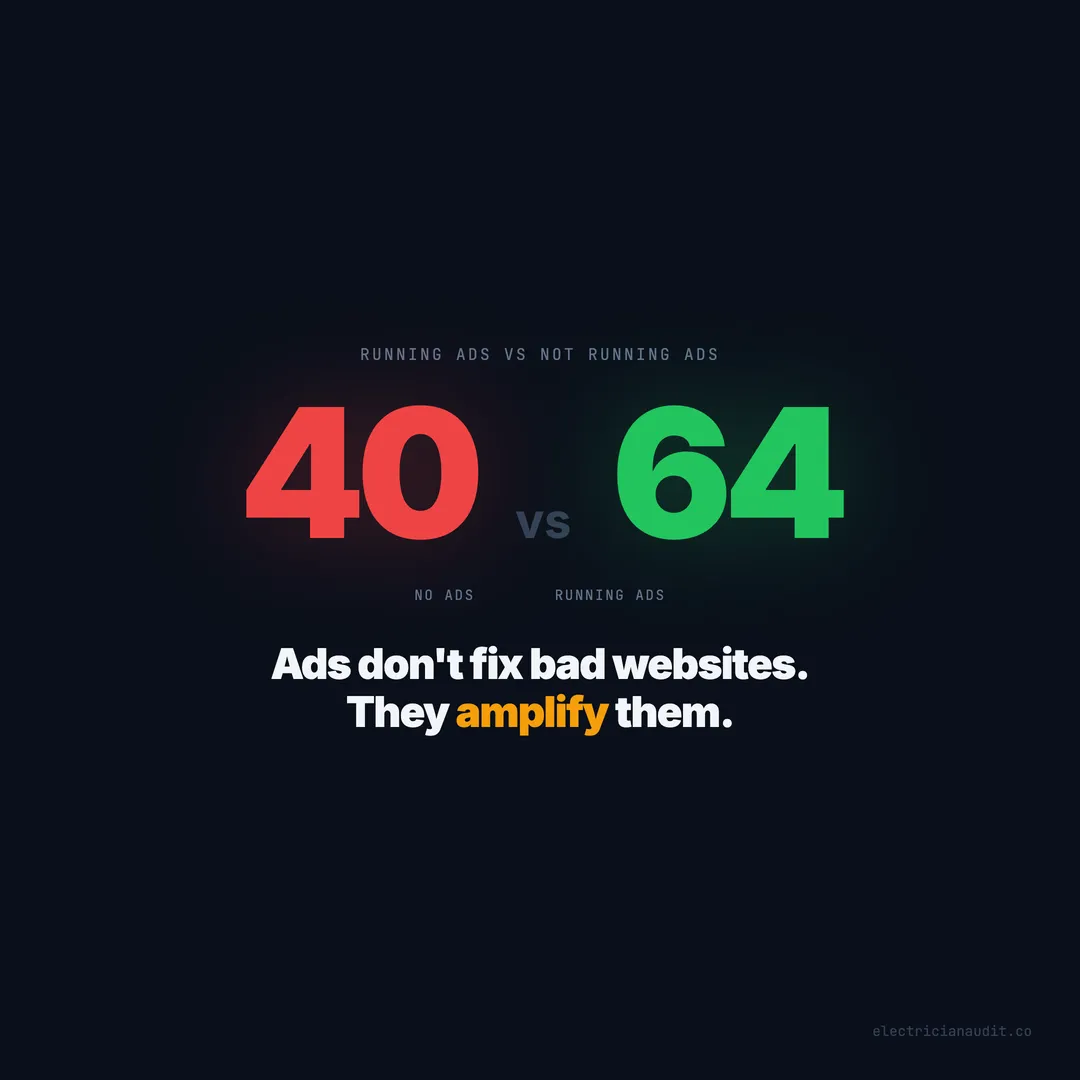
Electricians Spending on Google Ads Score 64/100. Everyone Else: 40.
We audited 1,259 electrician websites. The 24% running Google Ads scored 64/100 — but not because ads helped. Here's why most ad spend gets wasted.
You’re spending $3,000 a month on Google Ads. The clicks come in. The phone barely rings. You check the dashboard — 90 clicks, maybe 4 calls. Something between you and that click is broken, and it’s not the ad.
When we audited 1,259 electrician websites across nine states, we found something that explains this exact problem. The 24% of electricians running paid ads scored 64/100 on website quality. The other 76%? They averaged 40/100. That’s a 24-point gap.
But here’s what most people get wrong about that number. Ads didn’t make those websites better. The electricians who invest in growth tend to fix their site first, then turn on the ads. The ones who skip that step are lighting money on fire.
[ORIGINAL DATA] Across 1,259 deep-audited electrician websites, only 300 (24%) showed active Google Ads. Those 300 scored an average of 64/100 on website quality — a 24-point gap over the 76% without ads, who averaged 40/100.
The 24-Point Gap Between Ad-Runners and Everyone Else
Only 300 out of 1,259 electrician websites we audited were running Google Ads — that’s 24% of the market. Those 300 averaged a 64/100 site quality score. The remaining 959 sites averaged 40/100. It’s one of the largest performance gaps in our entire national electrical market dataset.
This gap isn’t caused by ads. It’s a selection effect. Electricians who commit to paid advertising tend to be more growth-oriented. They’ve usually invested in their website already — HTTPS, booking systems, trust signals. The ad spend comes after the foundation is solid.
Think of it this way. Two electricians both pay $30 per click. One has a polished site with online booking, visible licensing, and a clear service area. The other has a five-page template with no contact form and no SSL. Same click cost. Completely different outcome.
The ad-runners don’t score higher because of Google Ads. They score higher because they treated the website as the conversion engine it needs to be before pouring fuel into it.
The Real Cost of Sending Paid Traffic to a Broken Website
Electrician Google Ads cost between $15 and $50 per click in most metro markets. At $30 per click average, a $3,000 monthly budget buys you roughly 100 clicks. That’s 100 potential customers landing on your website. But what happens when they arrive?
[UNIQUE INSIGHT] In our data, the majority of non-ad-running electrician sites lacked the basic conversion elements that make those clicks worthwhile. If even 75% of paid clicks land on a site without a clear path to booking or calling, a $3,000/month ad budget conservatively wastes $2,250 every month — $27,000 a year burned on traffic that can’t convert.
Here’s what we found among the 76% of electricians not running ads — the same group most likely to turn on Google Ads without fixing their site first:
| Missing Element | % of Sites Without It |
|---|---|
| Online booking | 84% |
| Service area pages | 70% |
| After-hours lead capture | 64% |
| HTTPS (SSL) | 60% |
| License number on site | 56% |
| Contact form | 53% |
Now picture this. A homeowner searches “electrician near me” at 9 PM. Your ad wins the click. They land on a site with no SSL padlock, no booking option, and no license number visible. What do they do? They hit back and click on the next result. You just paid $30 for a bounce.
53% of Electrician Sites Have No Contact Form — Clicks With Nowhere to Convert
More than half — 53% — of the electrician websites we audited had no contact form at all. Not a bad form. Not a hidden form. No form, period. Among the 76% not running ads, this number is even more alarming because these are the businesses most likely to struggle with converting website visitors.
A Google Ad click without a contact form is money thrown into a void. The visitor can’t fill out a request. They can’t describe their problem. They can’t schedule anything. Their only option is to call — and if it’s after 6 PM, nobody answers. That’s 64% of sites with no after-hours capture, which means two out of three electrical businesses are invisible to evening searchers.
And what about the 84% with no online booking? That homeowner who wanted to schedule a panel inspection for Saturday morning? Gone. They’ll book with the competitor who lets them pick a time slot right from the search result.
How much is a missed electrical job worth? One panel upgrade is $2,000 to $4,000. One whole-house rewire is $8,000 to $15,000. A single lost click at $30 doesn’t sound expensive until you realize the job behind it was worth thousands.
What the Top 24% Do Differently
The 300 electrician sites running Google Ads don’t just spend money on clicks. They’ve built websites designed to catch those clicks and turn them into calls. Here’s how the ad-running group compares on core conversion features.
Sites with a click-to-call button score 52 vs 32 — a 20-point gap. That’s the single largest feature gap in our dataset. Sites with dedicated service area pages score 59 vs 41, an 18-point gap. Online booking: 55 vs 39, a 16-point spread.
These aren’t coincidences. They’re compounding advantages.
| Feature | With Feature | Without Feature | Gap |
|---|---|---|---|
| Click-to-call | 52 | 32 | +20 pts |
| Service area pages | 59 | 41 | +18 pts |
| Online booking | 55 | 39 | +16 pts |
| After-hours capture | 57 | 41 | +16 pts |
| License displayed | 54 | 41 | +13 pts |
| Reviews on site | 56 | 43 | +13 pts |
| SSL + form + CTA combo | 55 | 43 | +12 pts |
[PERSONAL EXPERIENCE] When we manually reviewed the top-scoring ad-running sites, a pattern stood out. They didn’t just have these features — they had them on every landing page, not just the homepage. The panel upgrade page had its own booking widget. The EV charger page had its own service area map. Each page was its own conversion machine.
The top 24% treat their website like a sales floor. Every page has a job to do. The other 76% treat it like a digital business card — and then wonder why the ads don’t work.
60% of Electrician Websites Lack HTTPS — Paid Traffic Landing on “Not Secure” Pages
Six out of ten electrician websites in our audit had no HTTPS redirect. That means visitors see a “Not Secure” warning in their browser bar. Now imagine paying $30 to $50 per click to send someone to a page that Chrome actively flags as untrustworthy.
This is one of the cheapest problems to fix — most hosts offer free SSL certificates. But 60% of the market still hasn’t done it. Pair that with the 56% who don’t display a license number anywhere on their site, and you have a trust crisis.
Homeowners aren’t electricians. They can’t evaluate your technical skill from a website. So they rely on signals: padlock icon, license number, insurance badge, reviews. When those signals are missing, the site feels amateur. When a site feels amateur, the visitor feels risk. When the visitor feels risk, they bounce.
Google’s own data shows that 53% of mobile users abandon a site they don’t trust. For electricians specifically, trust matters more than most trades — you’re asking someone to let a stranger rewire their home.
The 76% Who Aren’t Running Ads Are Invisible AND Unconvertible
Let’s talk about the majority. Three out of four electrician websites in our dataset aren’t running Google Ads at all. That doesn’t automatically make them smart savers. In most cases, it means they’re relying entirely on organic search and word-of-mouth — with a site that scores 40/100.
That 40/100 average hides a brutal reality. 70% of these sites have no service area pages, which means Google doesn’t know which neighborhoods they serve. 84% have no online booking. 95% have no schema markup, so search engines can’t even parse their content properly.
Without ads and without SEO fundamentals, these businesses depend entirely on their Google Business Profile and referrals. That works until a competitor in your zip code starts running ads against your brand name. Then you’re losing jobs you didn’t even know existed.
Here’s the uncomfortable question: if your website scores below 40, would running ads even help? Or would you just be paying to expose more people to a site that can’t convert?
Ads Don’t Fix Bad Websites — They Amplify Them
This is the line worth repeating. Ads don’t fix bad websites. They amplify them. A great ad campaign driving traffic to a broken site doesn’t produce leads — it produces expensive bounces.
We see this pattern across our entire national market report. The electricians scoring above 80/100 represent just 1.9% of all sites — 26 out of 1,390 total audited. These are the businesses where Google Ads actually perform. They have the SSL, the forms, the booking, the trust signals, and the service pages. When a $30 click arrives, it has somewhere to go.
For everyone else, the math looks grim. If your conversion rate on a broken site is 2-3%, you’re paying $1,000 to $1,500 per lead from ads. Fix the site first — bring that conversion rate to 8-10% — and the same $3,000 monthly budget generates three to four times the leads.
The order matters: foundation first, fuel second.
The Fix Priority: Website First, Then Ads
If you’re already running ads and getting poor results, don’t increase your budget. Fix your website. If you’re not running ads yet, don’t start until your site can handle the traffic. Here’s the priority stack based on what actually moves the score.
Tier 1 — Fix today (biggest impact on conversion):
- Add click-to-call on every page. Sites with click-to-call score 52 vs 32 without it. This is a 20-point gap and takes 15 minutes to implement.
- Install SSL / HTTPS. 60% of sites don’t have it. Free with most hosts. Removes the “Not Secure” warning that kills trust instantly.
- Add a contact form. 53% of sites are missing one. Even a simple name-email-phone form gives visitors a way to reach you when they don’t want to call.
Tier 2 — Fix this week (multiplies your ad ROI):
- Build service area pages. 70% of electrician sites don’t have them. These pages tell Google and visitors exactly where you work — and sites with them score 18 points higher.
- Add online booking. 84% of sites lack it. Booking widgets convert visitors who don’t want to pick up the phone — especially younger homeowners.
- Display your license number. 56% of sites don’t. It’s the simplest trust signal in the electrical trade.
Tier 3 — Fix this month (compounds everything):
- Set up after-hours lead capture. 64% of electricians go dark after 6 PM. Emergencies don’t follow business hours. A simple form or chat widget captures leads while you sleep.
- Add reviews to your site. Sites with embedded reviews score 56 vs 43. Social proof is the last nudge before a visitor becomes a lead.
- Build landing pages per service. Don’t send panel upgrade searches to your homepage. Send them to a page about panel upgrades with its own CTA, pricing context, and booking option.
Every item on this list costs less than one week of Google Ads. Most cost nothing. But skipping them means every dollar you spend on ads works harder for your competitor than it does for you.
Your Ad Budget Deserves a Better Website
Here’s the bottom line. The 24% of electricians running Google Ads aren’t winning because of the ads. They’re winning because they built websites worth advertising. The other 76% are either invisible (no ads, no SEO) or bleeding money (ads pointing to broken sites).
The math is straightforward. At $30 per click, a $3,000 monthly budget sends 100 visitors to your site. If your site converts at 3% because it’s missing basic trust signals and booking options, you get 3 leads. Fix the site, push that to 10%, and the same budget delivers 10 leads. Same money. Three times the return.
Only 1.9% of electrician websites score above 80. That’s 26 out of 1,390. The bar is low. You don’t need to build a perfect website. You need to build one that’s better than the 98% of competitors who haven’t bothered.
Stop funding Google’s ad revenue with your conversion problem. Fix the site. Then flip the switch.
Keep reading
Want to know your score?
Drop your URL — full report in 48 hours.
We're on it.
Report in your inbox within 48 hours.