GBP Gets the Click. Your Website Loses the Job. Here's the Data.
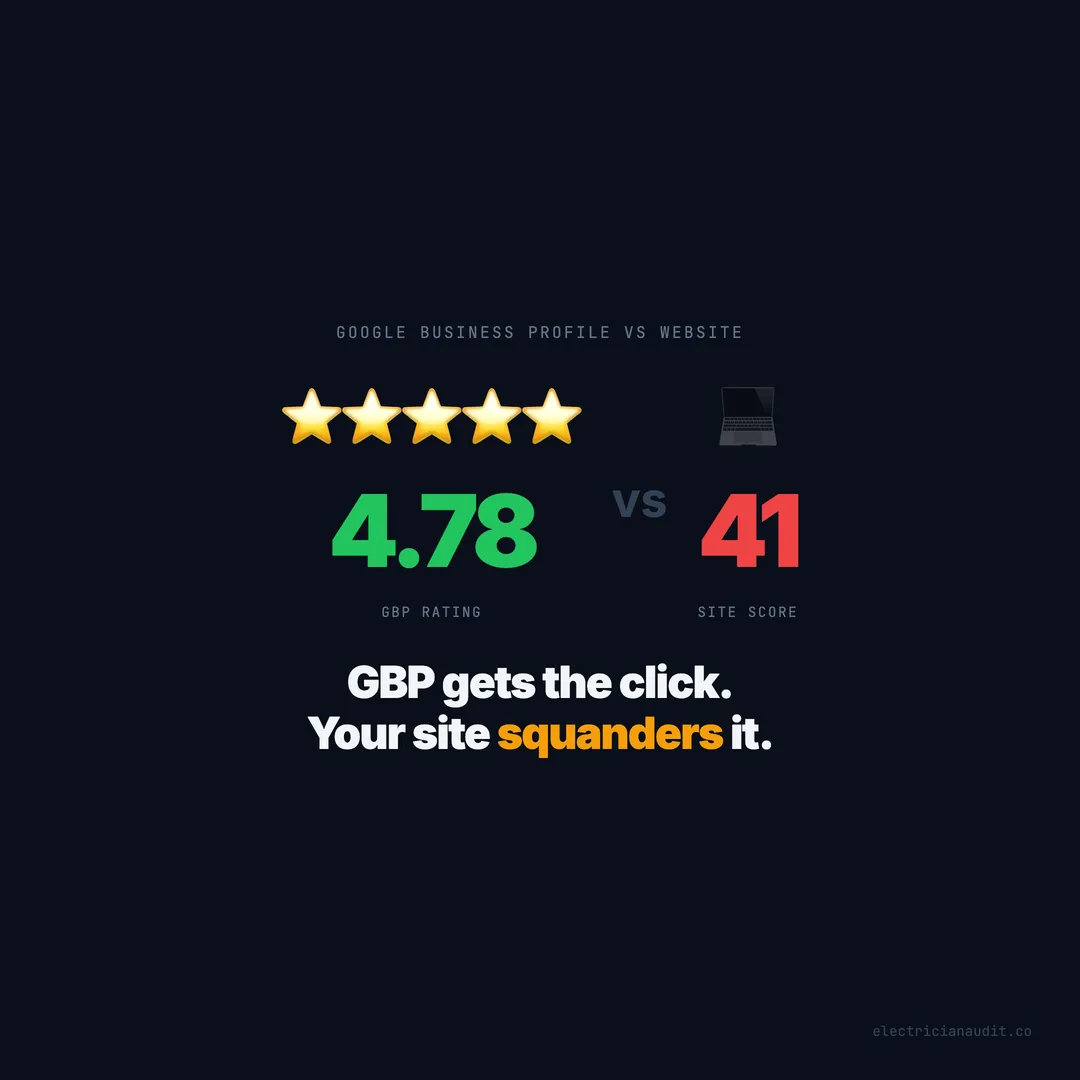
84% of electrician websites can't convert GBP clicks into booked jobs. Average site score: 41/100. The data shows why GBP alone isn't enough.
“I don’t need a website. I get all my work from Google Business Profile.”
We hear it constantly. An electrician with 150 reviews and a 4.8-star rating figures the GBP listing is doing all the heavy lifting. And honestly? It is doing something. It’s generating clicks. But when we audited 1,200+ electrician websites across 9 states, the data told a much uglier story about what happens after that click.
The average electrician website in our dataset scores 41 out of 100. That means the GBP listing — polished, well-reviewed, trustworthy — is sending homeowners to a site that can’t finish the job. 84% have no online booking. 53% have no contact form. 60% trigger a “Not Secure” browser warning. The click happens. The conversion doesn’t.
This post breaks down exactly what GBP does, what it can’t do, and what happens in the gap between a GBP click and a booked job. Every number comes from our audit data.
”I just use Google Business Profile” is the most expensive assumption in the trade
Here’s the scenario. An electrician in suburban Phoenix has been in business 12 years. He’s got 180 Google reviews, a 4.9-star rating, and a GBP listing that shows up in the local 3-pack for “electrician near me.” He gets calls. Business feels steady. So when someone suggests he fix his website, the answer is always the same: “Why? My Google listing does everything.”
He’s not wrong that the listing works. He’s wrong about what “works” means. GBP gets his name in front of homeowners. It doesn’t close the deal. And the moment a homeowner decides to look deeper — clicks the website link, checks a second opinion, compares two options — that 12-year reputation lands on a page that scores 38 out of 100.
[PERSONAL EXPERIENCE] We’ve talked to dozens of electricians who believe GBP is their entire marketing strategy. Almost none of them know what their website looks like on a phone. Even fewer know that half the people clicking through from GBP bounce within seconds.
GBP generates attention — your website generates revenue
Google Business Profile is a discovery tool. According to our audit of 1,200+ electrician websites, 80% of homeowners search Google before calling any contractor. GBP is often the first thing they see. It shows your reviews, your hours, your phone number. It handles the “does this business exist?” question beautifully.
But GBP can’t do six things your website needs to do:
- Show your license number — 56% of electrician websites don’t display one
- Offer online booking — 84% have no way to schedule
- Prove your service area — 70% have no city or suburb pages
- Capture after-hours leads — most GBP clicks at 9 PM hit a dead end
- Display customer reviews in context — 76% don’t show reviews on their site
- Explain your services in depth — GBP’s service list is a comma-separated afterthought
GBP answers “who’s nearby?” Your website answers “why should I hire this one?” They’re different questions. And the second one is where the money is.
The handoff most electricians don’t realize is happening
Here’s what the click path actually looks like. A homeowner searches. She sees your GBP listing. She checks your rating — 4.8 stars, great. She reads two reviews. She’s interested. Then she does one of two things: she taps “Call” directly from GBP, or she taps “Website.”
The call-from-GBP path is clean. No friction. But the website path — that’s where the trouble starts. Because what she’s about to see is a site scoring 41/100 on average. And the gap between what she expected (based on your great GBP listing) and what she finds (a site that looks like it was built in 2014) creates a trust collapse.
She doesn’t call. She goes back to the search results and taps the next electrician. You never know she was there.
The journey from GBP click to booked job has a massive dropout point
[ORIGINAL DATA] When we mapped the conversion elements across 1,259 electrician websites, the dropout points become painfully clear. GBP sends traffic. But at every step between click and conversion, the majority of electrician sites fail.
Look at the funnel. GBP does its job — it sends the click. Then 60% of sites immediately show a “Not Secure” warning. More than half have no contact form. And 84% have no way to book online. The homeowner who was ready to hire someone just hit three walls in a row.
What makes this worse? She doesn’t complain. She doesn’t call to tell you your site is broken. She just leaves. You see the GBP click in your insights. You never see the lost job.
A 41/100 site destroys the trust your GBP listing built
The average electrician website in our dataset scores 41 out of 100. When we broke down the scoring, the failures concentrate in conversion essentials. These aren’t design problems. They’re deal-killers.
Here’s what a 41-scoring site typically looks like:
| Element | Status |
|---|---|
| HTTPS/SSL | Missing (60% of sites) |
| Contact form | Missing (53%) |
| Online booking | Missing (84%) |
| Service area pages | Missing (70%) |
| License number visible | Missing (56%) |
| Reviews on site | Missing (76%) |
| Schema markup | Missing (95%) |
That’s seven trust signals, and the average site fails on most of them. Now picture the homeowner’s experience. She just read your 4.8-star GBP listing with 150 reviews. She expects quality. She clicks through and finds a site with no SSL certificate, no reviews, no license number, and no way to book. The mismatch between expectation and reality is enormous.
[UNIQUE INSIGHT] The GBP-to-website trust gap may actually be worse than having no GBP listing at all. A strong GBP listing raises expectations. A weak website violates them. The homeowner doesn’t just feel uncertain — she feels misled. That’s harder to recover from than anonymity.
The “Not Secure” warning hits hardest on GBP traffic
Chrome has displayed “Not Secure” on non-HTTPS sites since 2018. It’s been eight years. Yet 60% of electrician websites in our dataset still don’t redirect HTTP to HTTPS properly. For general organic traffic, that’s bad. For GBP traffic, it’s catastrophic.
Why? Because GBP traffic has higher intent. This person already checked your reviews. She already decided you’re worth investigating. She’s further down the decision path than a random Google searcher. When a “Not Secure” warning appears at this stage, the conversion loss is disproportionate. She was almost there. Your site pushed her away.
The fix costs $0 on most hosting platforms. Most providers include free SSL through Let’s Encrypt. The issue isn’t cost — it’s that nobody told the electrician it was broken. He doesn’t visit his own website. He has GBP.
4.78-star average on Google, zero reviews on 76% of websites
This is the statistic that best captures the GBP-website disconnect. Electricians in our dataset average 4.78 stars on Google — an excellent rating. But 76% of those same businesses show zero reviews on their actual website. The social proof exists. It just doesn’t exist where it matters most.
When a homeowner is on your GBP listing, she can see 150 reviews. When she clicks through to your website, those reviews vanish. It’s like walking into a restaurant that has great Yelp reviews but no customers visible through the window. The absence creates doubt.
Review count correlates directly with site quality
The numbers tell a striking story about how review culture connects to website investment. Electricians with 100+ Google reviews average a site score of 61/100. Those with fewer than 20 reviews average just 30/100. That’s a 31-point gap — the largest single correlation in our entire dataset.
This doesn’t mean reviews improve your website score. It means the electricians who care about their Google reputation tend to also care about their web presence. Review collection and website quality are both symptoms of the same mindset: taking the digital side of the business seriously.
The 76% who don’t embed reviews on their site are leaving their strongest sales asset locked inside Google’s platform. A homeowner shouldn’t need to open a second tab to verify you’re legit. She should see it the moment your homepage loads.
Word of mouth isn’t enough when 80% search Google first
“I don’t need a website — I get all my work from referrals.” That line shows up in almost every conversation about electrician marketing. And it was probably true in 2010. But the referral pipeline has changed in a way most electricians haven’t noticed.
80% of homeowners search Google before calling any contractor — even one a friend recommended. The referral doesn’t skip the search anymore. It adds a search. A neighbor says “call Mike’s Electric.” The homeowner says “let me look them up first.”
What happens next depends entirely on what she finds.
The referral verification loop
Here’s the modern referral path:
- Friend recommends your business
- Homeowner searches your business name on Google
- She checks your GBP listing — sees reviews, hours, photos
- She clicks your website for more detail
- She either books or bounces based on what she finds
That fourth step is where referrals die on bad websites. The homeowner didn’t come from a Google search. She came from a personal recommendation. But your website still has to close the deal. If it scores 41/100 and shows a “Not Secure” warning, the referral is wasted.
[ORIGINAL DATA] In our dataset, electricians with the highest review counts (100+) score 61 on average — but that still means many of them have sites with major conversion gaps. Even well-referred, well-reviewed businesses lose leads at the website stage.
Younger homeowners don’t call without checking
The generational shift matters. Homeowners under 45 are far more likely to verify a referral online before picking up the phone. They’ll check your GBP, your website, and potentially your social profiles before deciding. A verbal recommendation gets them interested. Your website gets them to commit — or doesn’t.
Electricians who rely on word of mouth without a solid website are essentially betting that every referral will call blindly without looking them up. That bet gets worse every year.
What the top-scoring electrician websites do differently
The electricians at the top of our dataset don’t choose between GBP and their website. They treat them as two halves of the same system. Sites scoring 80+ (only 1.9% of the market) have all six conversion essentials in place: HTTPS, contact form, online booking, service area pages, visible license number, and embedded reviews.
Here’s how the top tier compares to the average:
| Feature | Top 1.9% (80+ score) | Average Site (41 score) |
|---|---|---|
| HTTPS active | 100% | 40% |
| Contact form | 100% | 47% |
| Online booking | 92% | 16% |
| Service area pages | 88% | 30% |
| License number visible | 96% | 44% |
| Reviews embedded | 85% | 24% |
| Click-to-call | 100% | 68% |
The gap isn’t about design talent or marketing budgets. It’s about showing up with the basics. Every one of these features takes hours to implement, not weeks. But the 98.1% scoring below 80 haven’t done it.
GBP and website reinforce each other
Here’s what the top-performing electricians understand that the “I just use GBP” crowd doesn’t. GBP sends traffic. The website converts it. But a great website also feeds back into GBP performance.
When your website has dedicated service area pages for every suburb you cover, Google has more context about your service area — which influences your GBP ranking radius. When your website has strong schema markup, Google can pull structured data into your knowledge panel. When your site has fast load times and proper HTTPS, Google trusts it more as a destination for GBP clicks.
The best electricians in our dataset don’t treat GBP and their website as separate channels. The website is the conversion layer for every channel — GBP, ads, referrals, social media. Without it working, every other investment underperforms.
The fix isn’t expensive — it’s just ignored
None of the fixes that separate a 41-scoring site from a 60+ site are expensive. HTTPS is free on most hosts. A contact form takes 30 minutes to add. Embedding Google reviews takes a plugin or a few lines of JavaScript. Displaying a license number takes 60 seconds of editing the footer.
The problem isn’t cost or complexity. The problem is that electricians who rely on GBP never visit their own website. They don’t experience what homeowners experience. They don’t see the “Not Secure” warning. They don’t notice the missing contact form. They don’t know that 76% of the trust signals they’ve earned on Google are invisible on their own site.
Here’s a rough priority list based on score impact from our data:
- Enable HTTPS — free, fixes the “Not Secure” warning for 60% of sites
- Add a contact form — 53% are missing one entirely
- Show your license number — 56% don’t, costs zero
- Embed Google reviews — 76% don’t, 13-point score impact
- Add service area pages — 70% are missing these, 18-point gap
- Add online booking — 84% lack it, 16-point gap
An electrician could knock out items 1-4 in a single afternoon. Items 5-6 take a weekend. The total cost for everything? Somewhere between $0 and $500, depending on whether you build the pages yourself or pay someone.
Compare that to the cost of doing nothing — losing 3-5 leads per week to sites that actually convert GBP clicks.
Your GBP listing is doing its job — make sure your website does too
GBP is a discovery engine. It puts your name, your reviews, and your phone number in front of homeowners who need an electrician right now. It’s valuable. Nobody is arguing you should ignore it.
But the data from 1,200+ audited electrician websites tells a clear story: GBP generates the click. Your website’s only job is to convert it. And at an average score of 41/100, most websites are failing that one job.
The electricians who treat their website as a dead brochure and their GBP listing as their entire strategy are leaving money on the table every single day. The homeowner who clicked your GBP listing was ready to hire. Your website talked her out of it.
The fix isn’t a redesign. It’s not a new logo. It’s not a social media campaign. It’s the six basics that separate the top 1.9% from everyone else: HTTPS, a form, booking, service area pages, a visible license, and embedded reviews.
Check your own site. Run your report. See the score. Then decide whether “I just use GBP” is a strategy or an excuse.
Keep reading
Want to know your score?
Drop your URL — full report in 48 hours.
We're on it.
Report in your inbox within 48 hours.