56% of Electricians Got Licensed — Then Forgot to Put It on Their Website
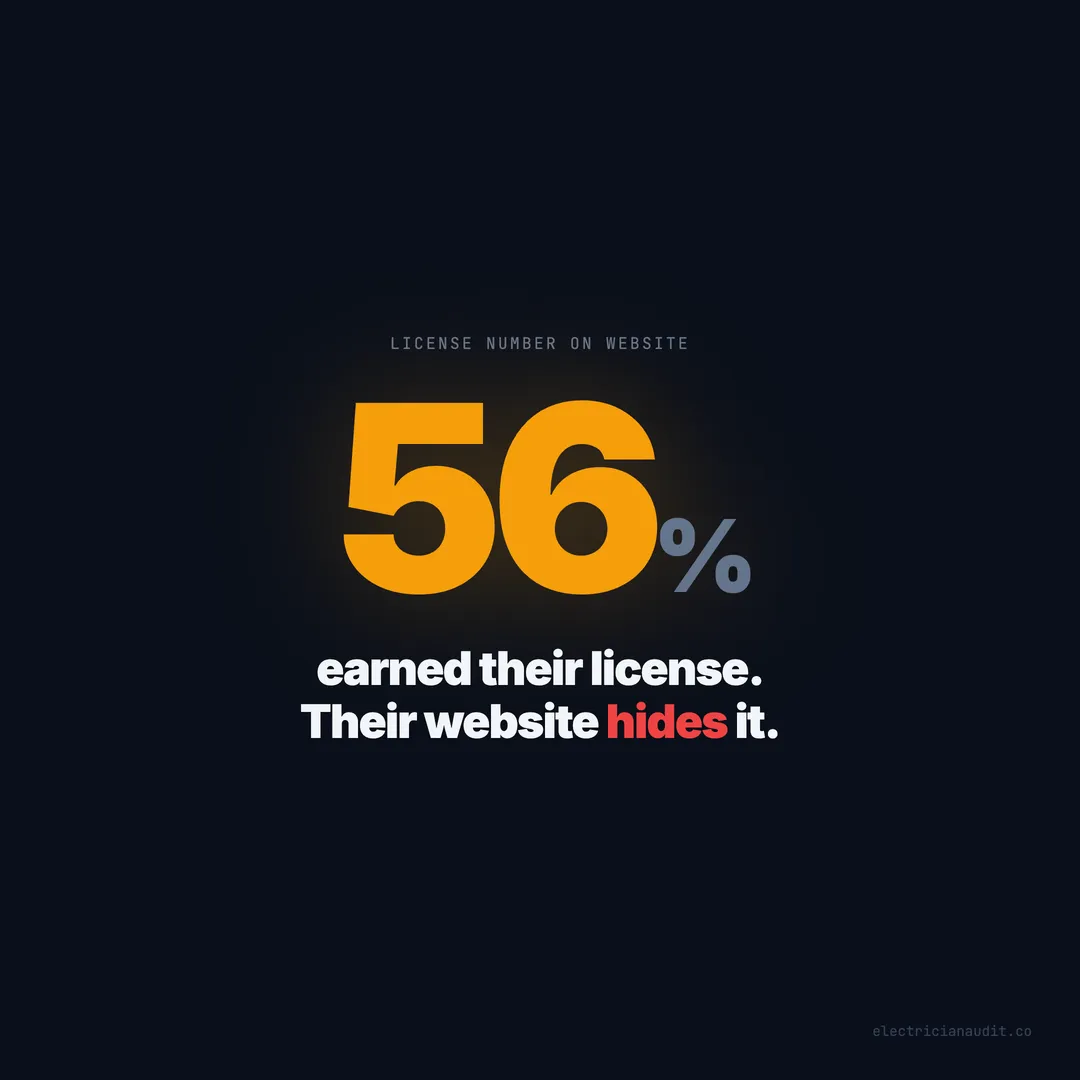
56% of electrician websites don't display a license number anywhere. Sites that show one score 54/100 vs 41 without — a 13-point gap that's costing real jobs every month.
A homeowner needs a panel upgrade. She searches “licensed electrician near me” and clicks two results. The first site has a license number in the footer, a state license badge in the header, “Licensed, Bonded & Insured” on the homepage, and three Google reviews embedded below. The second site has a stock photo of a guy in a hard hat, a phone number, and the word “professional” used four times.
Both electricians are licensed. Both carry insurance. Both have been in business for over a decade. But one of them looks indistinguishable from the unlicensed handyman who runs Facebook ads from his truck.
When we audited 1,200+ electrician websites across 9 states, 56% didn’t display a license number anywhere on their site. Not in the header. Not in the footer. Not on the about page. Nowhere. And 42% didn’t mention the words “licensed” or “insured” at all — not even once.
These aren’t fly-by-night operations. The average Google rating across our dataset is 4.78 stars. These are electricians with real credentials, real experience, and real reputations. They spent years earning those credentials. Then they built websites that hide every single one.
The 56% gap is a trust problem, not a design problem
This isn’t about aesthetics. When we compared sites that display a license number against those that don’t, the score gap was stark: 54/100 vs 41/100 — a 13-point difference. That gap doesn’t come from better design or fancier layouts. It comes from trust signals that homeowners can actually verify.
A license number is a specific, checkable credential. It tells a homeowner: this person passed a state exam, carries the required insurance, and can be held accountable through a licensing board. Without it, your website makes the same claims as everyone else — “experienced,” “professional,” “quality work” — and none of those words mean anything without proof.
42% of sites in our audit don’t even use the phrase “licensed and insured.” That’s almost half the industry presenting themselves online without the single most important differentiator they spent years earning.
The homeowner doesn’t know you passed your journeyman exam at 22, got your master license at 28, and have maintained your bond for 15 years. Your website doesn’t tell her. So she compares you against the next search result — and you both look the same.
What a license number actually signals
A visible license number does three things a homeowner processes in under two seconds:
- Accountability — she can look it up on the state licensing board website
- Legitimacy — unlicensed operators can’t display one because they don’t have one
- Confidence — it tells her you’re proud of your credentials, not hiding behind vague language
Sites without a license number force the homeowner to trust the word “professional” at face value. Most won’t.
Reviews on your website close the same 13-point gap
The pattern repeats with reviews. Sites that embed reviews directly on their website score 56/100 vs 43/100 for sites that don’t — another 13-point spread. And this gap exists even though the average electrician in our dataset has a 4.78-star Google rating.
Think about what that means. Most electricians in our study have excellent reputations. But 76% don’t show a single review on their actual website. The reviews exist on Google. They exist on Yelp. They just don’t exist where the homeowner is making her decision — on your site.
When a homeowner lands on your homepage and sees your Google rating embedded with real customer names and real comments, she doesn’t need to leave your site to verify you. She can read what your last 10 customers said, see the dates, see the detail. That’s conversion fuel.
When she lands on a site with no reviews, she has to open a new tab, search your business name, find your Google profile, scroll through reviews, then navigate back. Every extra step loses people. Most won’t come back.
The review count multiplier
Review count matters as much as review presence. Electricians with 100+ Google reviews score 61/100 on average. Those with under 20 reviews average just 30/100. That’s a 31-point canyon — the single largest score gap in our entire dataset.
It’s not that review count directly improves your website. But electricians who actively collect reviews tend to invest more in their entire online presence. The review count is a proxy for how seriously you take the digital side of your business.
Combined trust signals separate the top third from the bottom half
Here’s where the compounding kicks in. Sites displaying both a license number and embedded reviews cluster in the top third of our scoring. Sites with neither sit in the bottom half. The combination matters more than either signal alone.
Trust signals don’t add — they multiply. A license number alone nudges the score up. Reviews alone nudge it up. But together, they create the kind of credibility stack that makes a homeowner stop comparison-shopping and pick up the phone.
Research consistently shows that trust signals increase conversion rates by 30-40% for home service businesses. That’s not traffic — that’s the percentage of visitors who actually become leads. On a site getting 500 visits a month, the difference between a 3% and a 4.5% conversion rate is 7 extra leads. At $300-$500 per job, that’s $2,100-$3,500 in monthly revenue from trust signals alone.
The credibility stack in action
The highest-scoring sites in our audit stack trust signals in a specific pattern:
| Signal | Where it appears | % of top-third sites |
|---|---|---|
| License number | Header or footer | 89% |
| “Licensed, Bonded & Insured” | Homepage hero | 82% |
| Google reviews embedded | Homepage + service pages | 78% |
| Service guarantee | Below hero or in sidebar | 65% |
| Insurance certificate link | About or footer | 41% |
The bottom-half sites? Most had zero of these. They relied entirely on the word “professional” and a phone number.
4.78 stars and nobody knows — the hidden reputation problem
The average electrician in our dataset has a 4.78-star Google rating. That’s excellent. That’s the kind of reputation built over years of showing up on time, doing clean work, and treating customers right.
But a Google rating only helps when people see it. And there’s a gap between where electricians earn their reputation and where homeowners make decisions.
A homeowner searching for an electrician will check Google reviews — but she’s also landing on your website, scanning your homepage, reading your about page. If your site doesn’t surface your rating, she has to open a second tab, search your business name on Google, and find your profile. Every extra click is a chance for her to find your competitor instead.
Electricians with 100+ reviews score 61/100. Those with fewer than 20 reviews average just 30/100. The reputation exists. The website just doesn’t show it.
Embedding your Google reviews takes about 10 minutes with a free widget. The score gap between showing and hiding them is 13 points. That’s one of the highest-return, lowest-effort fixes in our entire dataset.
The money math — what hidden credentials cost per month
Let’s put dollar signs on this. Trust signals don’t just improve scores — they convert visitors into calls.
A typical electrician website gets 300-600 organic visits per month. Most convert at 2-3% — meaning 6-18 leads. Sites with visible trust signals (license, reviews, insurance mention, guarantee) convert at 4-5%. That’s 12-30 leads from the same traffic.
The difference is 6-12 extra leads per month without spending a dollar on ads.
| Metric | Without trust signals | With trust signals |
|---|---|---|
| Monthly visits | 500 | 500 |
| Conversion rate | 2.5% | 4.5% |
| Monthly leads | 12 | 22 |
| Avg job value | $400 | $400 |
| Monthly revenue from web | $4,800 | $8,800 |
| Revenue gap | $4,000/month |
That $4,000 monthly gap adds up to $48,000 per year in revenue you’re leaving on the table — not because you’re a bad electrician, but because your website isn’t converting the visitors it already gets.
And here’s the part that should sting: you already did the hard work. You completed your apprenticeship. You passed your exams. You got bonded. You carry insurance. You earned 4.78 stars from real customers. The only thing you didn’t do was tell your website about it.
The unlicensed handyman looks just as credible as you
Here’s the part that should bother every licensed electrician reading this.
You spent 4 years as an apprentice. You put in 8,000 hours of supervised work. You passed your journeyman exam. Maybe you went further and got your master electrician license. You pay for your bond renewal every year. You carry $1 million in liability insurance. You maintain your continuing education credits.
The handyman down the street did none of that. He watched YouTube videos, bought tools at Home Depot, and built a $500 Wix site that says “Professional Electrical Services.”
Your websites look the same.
That’s not an exaggeration. When we audited 1,200+ electrician websites, the sites that hide their credentials are functionally indistinguishable from unlicensed operators. No license number. No insurance mention. No embedded reviews. Just a phone number and the word “professional.”
The homeowner can’t tell the difference. She’s not going to call the state licensing board and look you up — not when there are three other search results below yours. She’s going to pick the site that looks most credible. And right now, 56% of licensed electricians aren’t giving her any visible reason to choose them. If you’re wondering why your electrician website isn’t getting calls, this is a big piece of the answer.
This is a fixable problem. Every credential you’ve earned can be displayed on your website in under 15 minutes. The question is whether you’ll do it today or keep losing calls to someone who didn’t earn any of it.
The 15-minute fix — where to display every credential
You don’t need a redesign. You don’t need to hire a developer. You need to add specific trust signals in specific places, and most of it takes minutes.
License number placement
Your license number should appear in three places minimum:
- Website footer — every page of your site. Format: “License #EC-12345 | State Electrical Contractor”
- About page — in the first paragraph, alongside your years of experience and training background
- Homepage hero area — near your phone number or primary CTA, as a badge or text line
Some states let you link directly to your license verification page on the licensing board’s website. If yours does, link it. A clickable, verifiable license number removes all doubt.
”Licensed, Bonded & Insured” placement
This phrase — or a variation of it — should appear:
- Homepage hero — visible without scrolling, ideally as a badge or ribbon element
- Every service page header — reinforcing it on every entry point
- Google Business Profile description — for consistency across platforms
The phrase works because it’s specific. “Professional” is vague. “Licensed, Bonded & Insured” is a verifiable claim with legal weight.
Review embedding
Embedding Google reviews takes 10 minutes with a free widget. Here’s where to place them:
- Homepage — 3-5 recent reviews below the hero section, with your aggregate rating (“4.8 stars from 120+ reviews”)
- Service pages — reviews that mention the specific service (panel upgrades on the panel upgrade page, rewiring reviews on the rewiring page)
- Dedicated reviews page — your full review feed, pulling from Google automatically
Don’t screenshot reviews and paste them as images — those look fake and don’t update. Use a widget that pulls live data from your Google profile. Options like EmbedSocial, Elfsight, or a simple Google Reviews embed script all work and are free or under $10/month.
Service guarantee
If you offer any kind of guarantee — satisfaction guarantee, workmanship warranty, on-time guarantee — display it prominently. 65% of top-third sites in our audit display a service guarantee. Only 12% of bottom-half sites do.
A guarantee doesn’t need to be complicated. “100% satisfaction guaranteed or we’ll come back and make it right — free” is enough. Put it on the homepage, near your CTA, and on every service page.
What the top-scoring electrician sites do differently
The top-scoring sites in our 1,200-site audit don’t have bigger budgets or fancier designs. They stack trust signals systematically. Here’s what separates them from the average:
| Element | Top third (avg 58+) | Bottom half (avg <41) |
|---|---|---|
| License number visible | 89% | 31% |
| “Licensed & Insured” text | 91% | 44% |
| Reviews embedded on site | 78% | 19% |
| Service guarantee displayed | 65% | 12% |
| Click-to-call button | 94% | 58% |
| After-hours contact option | 67% | 28% |
The gap isn’t one thing. It’s everything. The top sites treat their website like a digital storefront where credentials are displayed on the wall — just like they’d hang their license in the office. The bottom sites treat their website like a business card: name, number, done.
Only 1.9% of sites in our audit scored above 80. That means the bar is low. You don’t need to be perfect. You just need to be visibly credible. Want to see where your site falls? Check our free audit reports.
Your credentials aren’t optional — they’re your competitive advantage
Electricians sometimes treat their license and insurance as back-office paperwork. Something they maintain for compliance, not something they advertise. But in a market where 56% of competitors hide their credentials, displaying yours is an instant differentiator.
You didn’t sit through 8,000 hours of apprenticeship to look the same as someone who didn’t. You didn’t pass a state licensing exam so your website could say “call for a free estimate” and nothing else. You didn’t pay for a bond and liability insurance so the homeowner would have to guess whether you’re legitimate.
Every credential you earned is a reason for the homeowner to choose you over the next result. But only if she can see it.
The sites that display license numbers, embed reviews, and mention their insurance score 13 points higher. They convert 30-40% more visitors into calls. They don’t look like every other electrician — they look like the one worth hiring.
Fifteen minutes. That’s how long it takes to add your license number to your footer, drop a “Licensed, Bonded & Insured” badge on your homepage, and embed a Google review widget. Fifteen minutes to stop hiding the credentials you spent years earning.
The electricians already showing their license aren’t more qualified than you. They’re just not keeping it a secret.
Keep reading
Want to know your score?
Drop your URL — full report in 48 hours.
We're on it.
Report in your inbox within 48 hours.