62% Have No EV Charger Page, 63% No Generator Page
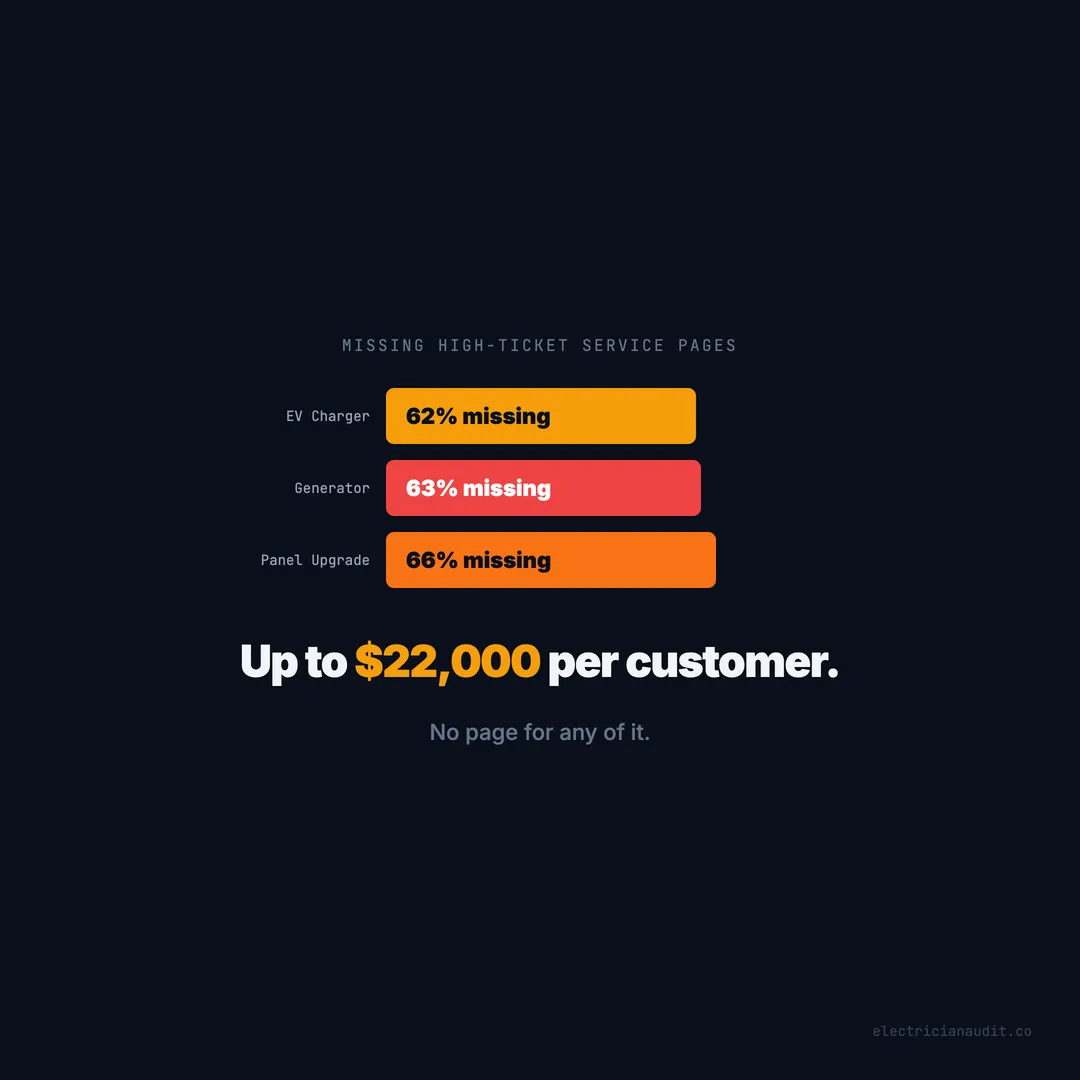
We audited 1,259 electrician websites. 62% have no EV charger page and 63% have no generator page — missing the highest-ticket services in residential electrical.
A homeowner just bought a Tesla. They walk into their garage, look at the 120V outlet, and realize they need a Level 2 charger installed. They pull out their phone and search “EV charger installation near me.”
Three electricians show up. None of them are you.
Not because you can’t do the work. Not because you don’t have the license. Because you don’t have a page for it. When we audited 1,259 electrician websites across nine states, 770 of them — 62% — had no dedicated EV charger installation page. Another 783 (63%) had no generator installation page. And 826 (66%) were missing panel upgrade pages entirely.
These aren’t niche services. They’re the three highest-ticket residential electrical jobs, representing $7,500 to $22,000 in combined revenue per customer. And most electricians aren’t even showing up for them.
This is the gap nobody’s talking about.
The EV Charger Page Gap Is Costing Electricians the Fastest-Growing Service
EV sales have been growing over 50% year-over-year in the U.S. Every one of those vehicles eventually needs a home charger. A single Level 2 EV charger installation runs $500 to $2,000+ depending on panel capacity and wiring distance. That’s a service with built-in, accelerating demand — and 62% of electrician websites don’t have a page for it.
Here’s what that looks like in practice. A homeowner in Charlotte buys an electric SUV. They search “EV charger installer Charlotte NC.” Google returns results from electricians who have a dedicated page with that exact service and city name. Your site? It says “residential electrical services” on one generic page. Google has no reason to rank you.
[ORIGINAL DATA] When we cross-referenced EV charger page presence with service area coverage, the problem compounds. 70% of electrician sites have no service area pages at all. That means you’re not just missing the service page — you’re invisible for the “[service] + [city]” searches that drive high-intent leads.
The search intent is specific and high-converting
Someone searching “EV charger installation” isn’t browsing. They’ve already bought the car. They need someone this week. This is bottom-of-funnel traffic — the kind that converts at rates generic “electrical services” pages never will.
Think about it this way. A homeowner searching “electrician near me” might need anything from a outlet replacement to a full rewire. A homeowner searching “Level 2 EV charger installation” needs one specific thing, they know the price range, and they’re ready to book. Which lead would you rather get?
63% Have No Generator Page — That’s $5,000 to $15,000 Per Missed Job
Whole-house generator installations run between $5,000 and $15,000. Some jobs with complex transfer switch setups go higher. When we checked 1,259 electrician sites, 783 of them (63%) had no dedicated generator installation page.
Picture hurricane season in Florida or Texas. Power goes out for three days. Every homeowner on the block starts Googling “whole house generator installer near me.” The electricians who show up in those results? They’ve got pages specifically about generator installation, standby generators, transfer switches, and storm prep.
[PERSONAL EXPERIENCE] We’ve reviewed hundreds of these sites now, and there’s a pattern. Electricians who DO have generator pages tend to be the same ones running ads, maintaining higher review counts, and scoring well above the average site score of 41/100. They’ve already figured out that specific service pages attract specific, high-value leads.
Missing one generator install per month adds up fast
Run the numbers. One missed whole-house generator installation per month at $10,000 average ticket = $120,000 per year you didn’t bid on. Even at a conservative close rate, that’s real money walking to competitors who simply had a page that said “we install generators.”
And generator demand isn’t seasonal in most markets. Florida, Texas, Louisiana, and Georgia — four of the nine states we audited — have hurricane exposure. Tennessee and the Carolinas get ice storms. Arizona has summer grid strain. The demand exists year-round; it just spikes during events.
The High-Ticket Service Page Gap at a Glance
Every one of these services represents a job worth more than a standard outlet install or fixture swap. And nearly every one is missing from a majority of electrician websites.
Notice the pattern. The highest-ticket services have the biggest gaps. Surge protection (94% missing) and rewiring (81% missing) are high-margin work too, but EV chargers and generators are where the real dollar-per-job numbers stack up.
Specific Service Pages Outperform Generic “Services” Pages Every Time
A single “Our Services” page that lists 15 things you do isn’t a service page. It’s a menu. And menus don’t rank.
Here’s why. Google matches search queries to pages. When someone searches “EV charger installation Houston,” Google looks for pages specifically about EV charger installation, ideally with Houston in the content. A bullet point buried on a generic services page doesn’t compete with a dedicated 800-word page that covers charger types, installation process, panel requirements, and pricing ranges.
[UNIQUE INSIGHT] There’s a compounding effect we’ve observed in our audits. Electricians who have dedicated pages for EV chargers, generators, AND panel upgrades tend to score significantly higher overall — sites with all three average a score of 58 vs. the 41/100 average. It’s not just the pages themselves. These are the businesses that treat their website like a lead generation tool, not a digital business card.
High-intent searches use specific language
Nobody types “electrician services” when they need a generator installed. They type “standby generator installation,” “Generac installer near me,” or “whole house generator cost.” Each of those queries deserves its own page — or at minimum, a dedicated section with real content.
The electricians winning these searches aren’t doing anything complicated. They’ve just built pages that match what people actually type.
Panel Upgrades Connect Everything — and 66% Are Missing That Page Too
Here’s the detail most electricians overlook in their marketing: both EV charger installations and generator installations frequently require a panel upgrade. A home running a 100-amp panel can’t safely add a 50-amp EV charger circuit and a 30-amp generator transfer switch without upgrading to 200 amps.
Panel upgrades run $2,000 to $5,000 per job. That means a single customer who needs an EV charger plus a panel upgrade is a $2,500 to $7,000 job. Add a generator? You’re looking at $7,500 to $22,000 from one household.
Yet 826 out of 1,259 sites we audited — 66% — had no dedicated panel upgrade page. That’s a service page that should be cross-linked from both the EV charger and generator pages, capturing customers at every entry point.
The upsell path that builds itself
When you have all three pages — EV charger, generator, and panel upgrade — they naturally reference each other. The EV charger page mentions that older panels may need upgrading. The generator page explains transfer switch requirements and panel capacity. The panel upgrade page links to both as reasons homeowners come to them.
This isn’t clever marketing. It’s just describing how the work actually goes. And it creates an internal linking structure that helps every page rank better.
The Revenue Math on Missing These Pages
Let’s get specific. Here’s what skipping these service pages costs over 12 months.
Miss just 2 EV charger installs per month at an average of $1,250 each. That’s $2,500/month, $30,000/year. Miss 1 generator install per month at $10,000 average. That’s $120,000/year. Combined with a few panel upgrades these jobs would’ve triggered: $180,000+ in annual revenue that went to electricians who had the right pages.
Are those exact numbers guaranteed? No. But the direction is clear. Even at half those rates, you’re looking at $90,000 in work you never had a chance to bid on — because your website didn’t tell Google you offer the service.
What These Service Pages Actually Need
This isn’t about writing novels. Each high-ticket service page needs a few core elements to rank and convert. Here’s the baseline.
EV charger installation page essentials
- Service description: Level 1 vs. Level 2, what you install, brands you work with
- Panel requirements: explain when a panel upgrade is needed (link to your panel upgrade page)
- Pricing range: even a ballpark like “$500-$2,000 depending on panel and wiring distance” beats silence
- Process overview: what happens from call to completion
- City-specific content: mention the areas you serve, or better yet, build dedicated service area pages
Generator installation page essentials
- Types covered: standby, portable transfer switch, whole-house
- Sizing guidance: how homeowners know what size they need
- Brand mentions: Generac, Kohler, Briggs & Stratton — these are search terms people actually use
- Transfer switch explanation: automatic vs. manual
- Permit and inspection notes: builds trust and demonstrates expertise
Panel upgrade page essentials
- When it’s needed: age of panel, amperage limits, adding major circuits
- 100-amp to 200-amp: the most common upgrade, explain it clearly
- Connection to other services: EV chargers and generators both as reasons to upgrade
- Safety angle: outdated panels, Federal Pacific, Zinsco — known problem panels
Each page should be 800 to 1,200 words minimum. Include your license number on every page — 56% of electrician sites don’t. Add a clear call-to-action: phone number, contact form, or booking link.
The 70% Service Area Gap Makes This Worse
Having an EV charger page is step one. But if you don’t have service area pages, you’re still invisible for localized searches.
70% of electrician websites have no service area pages. That means when someone searches “EV charger installation Katy TX” or “generator installer Jacksonville FL,” sites without city-specific content don’t compete. You need both the service page AND the geographic targeting.
The electricians winning right now have built a matrix: service pages x city pages. EV charger installation + Houston. Generator installation + Tampa. Panel upgrade + Charlotte. Each combination is a potential first-page ranking for a high-intent, high-ticket search.
Sites that combine service pages with service area pages score 59 vs. 41 on average — an 18-point gap that directly correlates with visibility and lead volume.
Three Pages, $22,000 Per Customer, Zero Excuse
The math is hard to argue with. Three service pages — EV charger, generator, panel upgrade — targeting the highest-ticket residential electrical work available. Combined job value: $7,500 to $22,000 per customer. Time to build all three pages: a weekend, maybe less.
Meanwhile, 62% of your competitors don’t have an EV charger page. 63% don’t have a generator page. 66% don’t have a panel upgrade page. The bar is on the floor.
EV adoption isn’t slowing down. Storm seasons aren’t getting milder. Aging electrical panels aren’t fixing themselves. The demand for these services is growing every quarter. The only question is whether your website tells anyone you do the work.
The electricians already showing up for these searches didn’t build anything fancy. They just built pages for the services they actually offer. That’s all it takes.
Check how your site stacks up against others in your market.
Keep reading:
Want to know your score?
Drop your URL — full report in 48 hours.
We're on it.
Report in your inbox within 48 hours.