84% of Electrician Websites Have No Emergency Services Page
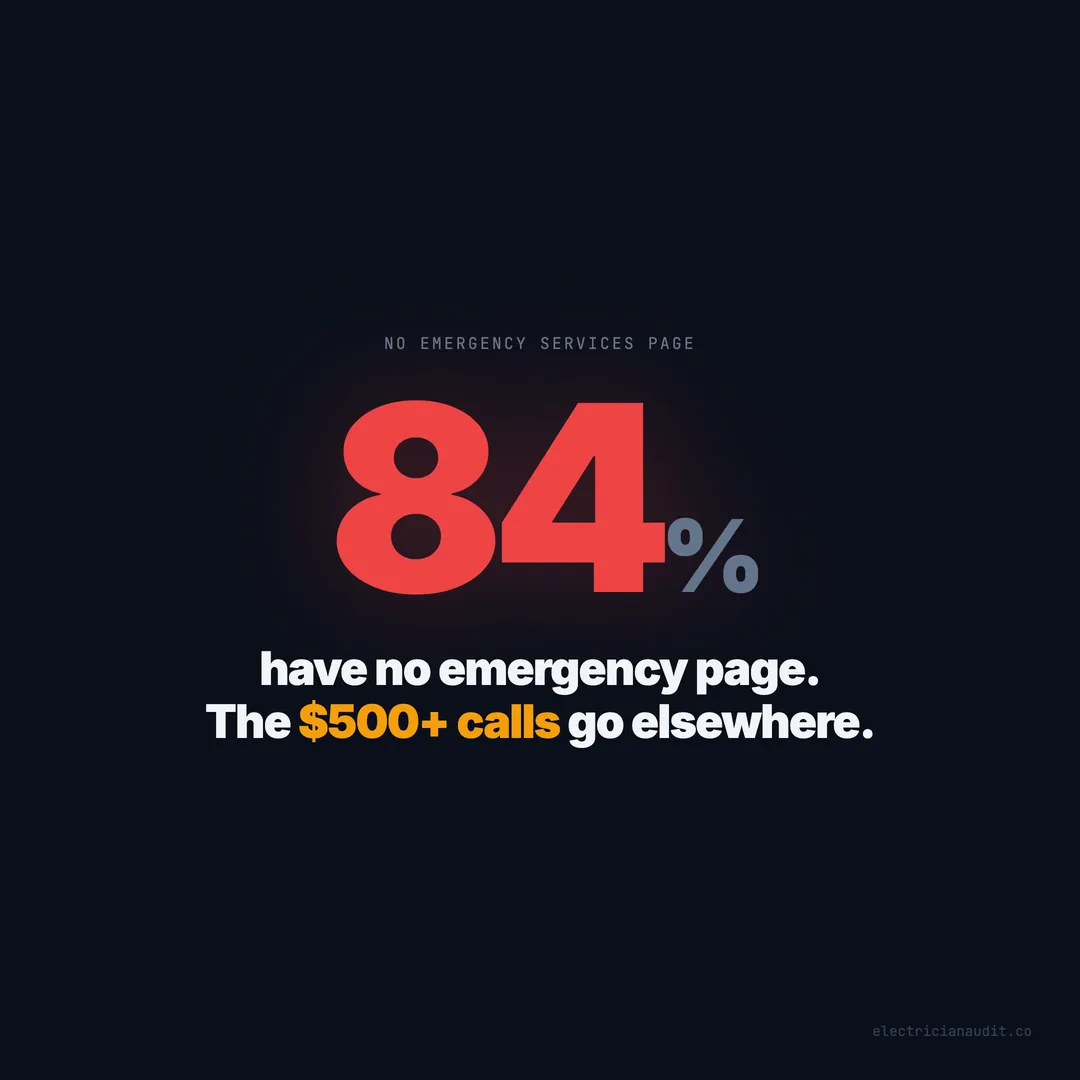
We audited 1,259 electrician websites and found 84% have no dedicated emergency page. That means $500+ emergency calls going to competitors every single week.
It’s 11:47 PM on a Tuesday. A breaker trips, half the house goes dark, and the homeowner smells something burning near the panel. They grab their phone. They Google “emergency electrician near me.” They’re not comparing prices. They’re not reading reviews. They want someone who can show up now — and they’ll pay whatever it costs.
Your website is one of the results. But there’s no emergency page. No mention of 24/7 service. No click-to-call button. No booking form. The next electrician in the results has all four. That homeowner calls them instead. The job pays $500 or more. You never knew it existed.
When we audited 1,259 electrician websites across 9 states, we found this scenario plays out constantly — because the vast majority of sites aren’t built to capture emergency work. The numbers are worse than most electricians realize.
84% of Electrician Websites Have No Dedicated Emergency Page
Out of 1,259 deep-audited electrician sites, 1,059 have no dedicated emergency services page. That’s 84%. Not buried content. Not a weak mention. A completely missing page for the highest-intent, highest-value search query in the electrical industry.
And it gets worse. Of those 1,259 sites, 559 have no emergency or 24/7 messaging anywhere — not in the header, not in the footer, not on any page. Nearly half of all electrician websites give zero indication they handle urgent calls.
Think about what that means for search. When someone types “emergency electrician [city],” Google is looking for pages that match that intent. A generic “Services” page with a bullet point mentioning emergency work doesn’t compete with a dedicated page that has “Emergency Electrical Services” in the title, URL, H1, and body text. The sites without that page aren’t even in the conversation.
We’ve seen this pattern across every market we’ve studied. The gap between what homeowners need at midnight and what electrician websites actually offer is massive.
Emergency Electrical Work Commands Premium Pricing
Emergency calls aren’t just frequent — they’re the most profitable jobs an electrician can take. Average emergency electrical service calls range from $400 to $800+, with panel-related emergencies and main breaker failures routinely exceeding $1,000. That’s 2-4x the revenue of a standard service call during business hours.
The reason is straightforward. Urgency eliminates price shopping. When a homeowner’s panel is sparking at midnight, they’re not calling three companies for quotes. They’re calling the first electrician whose website convinces them someone will actually show up.
This is what makes the missing emergency page so expensive. It’s not a low-value gap like a missing blog or an outdated footer. It’s the single most revenue-dense page an electrician’s website could have — and 84% of sites don’t have it.
Compare that to other common website gaps we found. Missing service area pages cost leads over time. Missing schema markup hurts rankings gradually. But a missing emergency page costs real dollars tonight, every time a homeowner searches and you’re invisible for that query.
The Search Query Electricians Are Ignoring
“Emergency electrician [city]” is one of the highest-intent, highest-CPC search queries in the electrical industry. Someone typing that phrase has an active problem, a willingness to pay a premium, and a need for immediate resolution. They aren’t browsing. They aren’t bookmarking for later. They’re hiring someone in the next five minutes.
Google’s own data shows that emergency-intent local searches have among the highest conversion rates in home services. And yet, when we looked at the 1,259 sites we audited, the vast majority have zero content optimized for these queries. No dedicated URL. No page title matching the query. No structured content addressing response times, service areas, or availability.
The electricians who do have a dedicated emergency page are playing a different game. They’re capturing the $500-$800 calls that everyone else doesn’t even know they’re losing. We’ve found that sites with after-hours capture features score 57 vs 41 compared to those without — a 16-point quality gap that reflects much larger revenue differences.
The Triple Loss: No Emergency Page, No After-Hours, No Booking
Here’s where the data gets brutal. These gaps don’t exist in isolation. They stack.
When we cross-referenced the emergency page gap with two other critical features — after-hours capture and online booking — the overlap was severe:
| Gap | Sites Missing It | % of 1,259 |
|---|---|---|
| No emergency services page | 1,059 | 84% |
| No after-hours capture | 806 | 64% |
| No online booking | 1,058 | 84% |
A huge portion of electrician websites fail on all three simultaneously. That means when a homeowner searches for an emergency electrician at 10 PM:
- No emergency page — your site doesn’t appear for the query
- No after-hours capture — even if they find you, there’s no way to reach you
- No online booking — they can’t schedule or request service instantly
Each gap alone costs jobs. Together, they create a near-total blackout for emergency revenue. The homeowner bounces in seconds and calls the competitor who has a bold “24/7 Emergency Service” header, a click-to-call button, and a booking form.
We’ve seen this exact pattern in market after market. The sites scoring above 80 (only 1.9% of all sites we audited) almost always have all three features. The average site, scoring 41 out of 100, usually has none of them.
What a Competitive Emergency Page Actually Includes
The electricians who are capturing these jobs aren’t doing anything complicated. Their emergency pages follow a consistent pattern. But the specifics matter — every missing element gives the homeowner a reason to hit the back button.
Immediate Trust Signals
A 24/7 availability badge, visible above the fold. Response time commitment — “On-site within 60 minutes” or “Same-day emergency service.” A real phone number, not a contact form buried below three paragraphs of text. License and insurance numbers displayed prominently. We found that 56% of electrician sites don’t even display a license number anywhere, which destroys trust for a homeowner considering a stranger in their home at midnight.
Conversion Elements
A click-to-call button that works on mobile. Sites with click-to-call score 52 vs 32 — a 20-point gap and the single largest quality score difference in our entire dataset. An online booking or service request form for homeowners who don’t want to call. A short list of common emergencies handled: panel failures, burning smells, power outages, exposed wiring, tripped breakers that won’t reset.
SEO Fundamentals
The page URL should include “emergency” — something like /emergency-electrician/ or /emergency-electrical-services/. The title tag should target the query: “Emergency Electrician in [City] | 24/7 Service.” And the page needs enough content (400+ words minimum) with natural mentions of emergency-related terms to actually rank.
None of this is expensive. None of it requires custom development. It’s a single page that most website builders can create in an afternoon. Yet 84% of the sites we audited don’t have it.
One Emergency Call a Week Changes the Math
Let’s make the revenue impact concrete. Forget best-case scenarios. Use conservative numbers.
One emergency call per week. Average ticket: $500. That’s $2,000 per month in additional revenue — $24,000 per year — from a single page on your website.
Now layer in the reality that emergency customers are often the best long-term customers. A homeowner who calls you at midnight because their panel failed isn’t comparison-shopping. If you show up fast and fix the problem, they remember. They call you for the panel upgrade next year. They recommend you to their neighbor. That initial $500 call has a lifetime value that’s multiples higher.
And consider the alternative. Without an emergency page, those callers go to your competitor. Not because your competitor is better. Not because they charge less. Simply because their website told the homeowner “we’re available right now” and yours didn’t say anything at all.
The sites running Google Ads without an emergency landing page are losing even more. We found that 24% of electrician sites run paid ads, and those sites score 64 vs 40 on average. But if they’re bidding on emergency keywords and sending traffic to a generic homepage, they’re paying for clicks that don’t convert. That’s money burned twice — once on the ad, once on the lost job.
The Service Page Gap Is Wider Than Just Emergencies
Emergency pages are the most costly gap, but they’re part of a larger pattern. When we mapped every service page across all 1,259 sites, the results were consistent:
| Missing Service Page | % of Sites |
|---|---|
| Surge protection | 94% |
| Solar panel electrical | 93% |
| Smoke/CO detector installation | 88% |
| Emergency electrical services | 84% |
| Rewiring | 81% |
| Ceiling fan installation | 81% |
| Lighting installation | 75% |
| Outdoor/landscape lighting | 75% |
| Panel upgrade | 66% |
| Generator installation | 62% |
| EV charger installation | 62% |
Every missing service page is a missing opportunity to rank for that specific query. But emergency pages carry disproportionate weight because of the pricing premium and the conversion urgency. A homeowner researching EV charger installation might take weeks to decide. An emergency caller decides in seconds.
The electricians scoring in the top 2% (above 80 out of 100) tend to have dedicated pages for at least 6-8 of these services. The average site at 41/100 usually has a single “Services” page with bullet points — if that.
Your Competitors Already Fixed This
Here’s the uncomfortable truth. The 16% of electrician websites that do have emergency pages aren’t doing anything extraordinary. They built one page. They put “24/7” in the header. They added a phone number that’s visible on mobile. That’s the entire competitive advantage.
The quality score gap tells the story. Sites with after-hours capture — which includes emergency messaging, chat widgets, and booking forms — score 57 compared to 41 for sites without. That 16-point difference translates directly to better rankings, more calls, and more revenue.
And it compounds. Sites with click-to-call score 52 vs 32. Sites with service area pages score 59 vs 41. Sites with online booking score 55 vs 39. The sites winning emergency work usually have all of these features working together. The sites losing emergency work usually have none of them.
We’ve published 682 individual audit reports at this point. The pattern is the same across Texas, Florida, Arizona, Georgia, and every other state in our dataset. The top-scoring sites capture emergency traffic. Everyone else is invisible after business hours.
Is your site one of the 84%? The fastest way to find out is to search “emergency electrician” plus your city name. If your site doesn’t show up on page one — or if it shows up but has no emergency-specific page — you already know the answer.
The Fix Takes an Afternoon, Not a Redesign
Building an emergency services page isn’t a six-month project. It’s one page with clear, specific content. Here’s the bare minimum that works:
Page structure:
- URL:
/emergency-electrician/or/emergency-electrical-services/ - H1 with “emergency electrician” + your city
- 24/7 badge or banner above the fold
- Click-to-call button (mobile-visible, large tap target)
- Response time promise (30 min, 60 min, same-day)
- List of 6-8 common emergencies you handle
- Service area for emergency calls
- License number and insurance info
- Simple booking/request form
Content minimums:
- 400-600 words of unique content
- Natural keyword usage (emergency, 24/7, urgent, same-day)
- Schema markup with
ElectricalContractortype - Internal links to related service pages
That’s it. One afternoon of work. The page starts ranking within weeks for emergency queries in your area. It starts capturing the $500+ calls that were going to competitors. And unlike paid ads, it doesn’t cost you anything per click.
The gap is real. The money is real. And 84% of your competitors still haven’t built this page. That won’t last forever.
Keep reading
Want to know your score?
Drop your URL — full report in 48 hours.
We're on it.
Report in your inbox within 48 hours.