95% of Electrician Websites Have No Image Alt Tags — Google Can't See Your Work
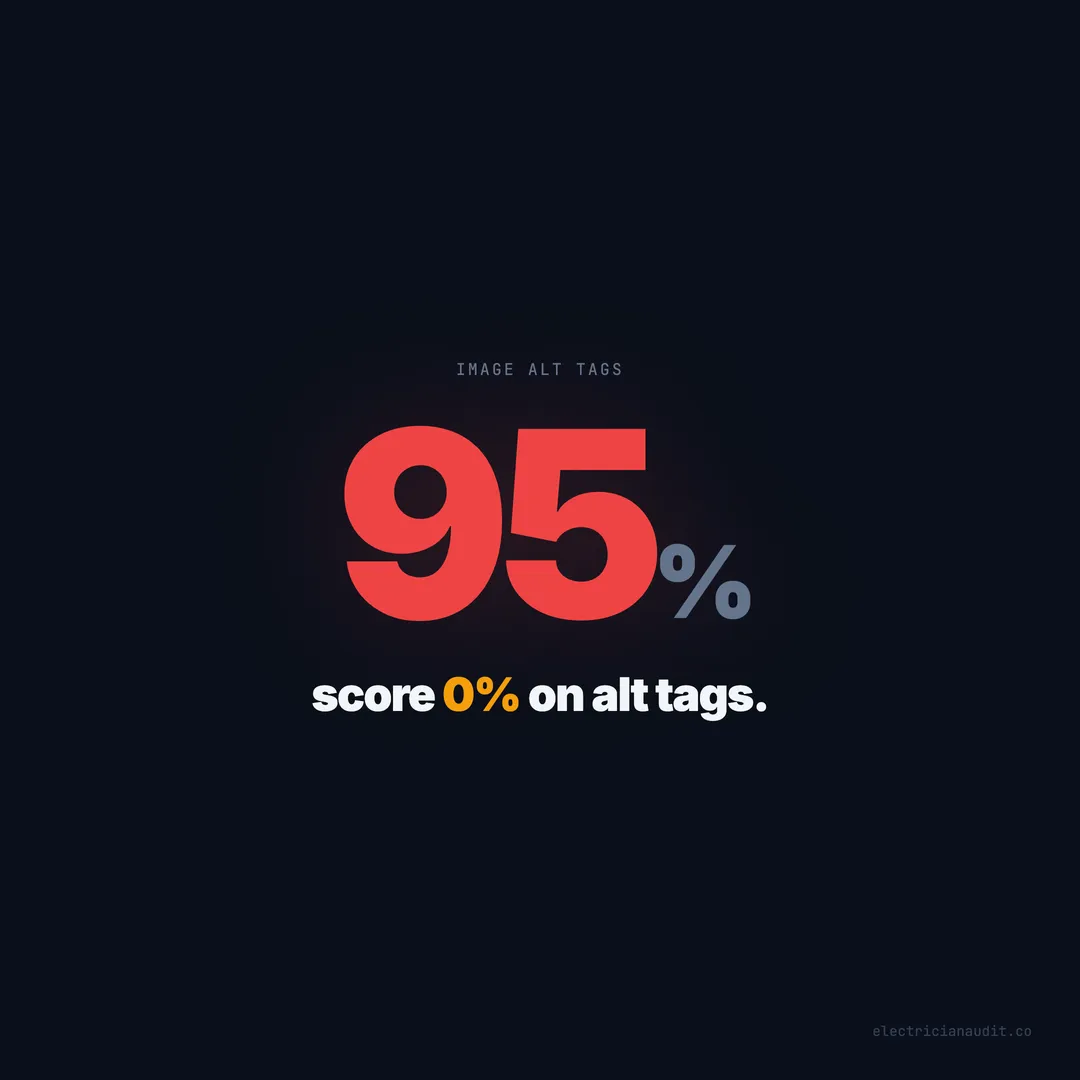
95% of electrician websites score 0% on image alt tags. A 10-minute fix unlocks Google Image Search traffic, accessibility, and higher audit scores.
A homeowner in San Antonio searches “200 amp panel upgrade” and taps Google Images. Dozens of photos load — breaker panels, conduit runs, labeled circuits. She clicks one that shows a clean install with a service sticker visible. That click lands on a competitor’s website. Your site has better photos of better work. But your images have no alt tags, so Google doesn’t know they exist. You’re invisible in the one search channel where your craftsmanship could sell itself.
When we audited 1,200+ electrician websites across 9 states and 51 cities, 95% had missing or useless image alt text (Electrician Audit, 2026). Not weak descriptions. Not slightly off. Empty alt attributes, no alt attributes at all, or auto-generated filenames like “IMG_4872.jpg.” These sites upload photos of real electrical work and then make those photos invisible to every search engine and screen reader on the internet.
The fix takes about 10 minutes per page. It costs nothing. And because 95% of your competitors haven’t done it, you don’t need to be great at it — you just need to do it at all.
TL;DR: 95% of electrician websites have no image alt tags, making their work photos invisible to Google Image Search and screen readers. Adding descriptive alt text takes 10 minutes per page and puts you ahead of nearly every competitor on a metric tied to accessibility, image search traffic, and overall site quality (Electrician Audit, 2026).
[INTERNAL-LINK: “audited 1,200+ electrician websites” -> /blog/we-audited-1200-electrician-websites/]
95% of electrician websites score 0% on image alt coverage
The number matches the other two near-universal failures in our dataset. Schema markup, meta descriptions, and image alt tags all hit the same 95% failure rate across 1,259 deep-audited sites (Electrician Audit, 2026). But alt tags might be the most avoidable of the three — because they require no technical knowledge, no plugins, and no code.
Here’s what “0% alt coverage” means in practice. You open the page source of an electrician’s website and look at the <img> tags. Where there should be an alt attribute describing the image — something like “residential panel upgrade from 100 to 200 amps in a Dallas home” — you find nothing. Or you find alt="". Or alt="IMG_3847.jpg". Google crawls that page, sees twelve images, and understands zero of them.
Electricians are visual tradespeople. Panel upgrades, rewiring, EV charger installs, lighting retrofits — this is work that photographs well. The irony is thick: the sites with the best photo galleries are often the same sites where Google can’t identify a single image. All that work, documented and uploaded, then sealed behind a wall of missing metadata.
[ORIGINAL DATA] We checked alt tag coverage on every audited site’s homepage and top service pages. The 95% figure isn’t based on partial coverage — it represents sites where fewer than 10% of images had any meaningful alt text. Most had literally 0%.
Citation capsule: Across 1,259 electrician websites audited in 9 states and 51 cities, 95% had missing or useless image alt text — the same failure rate as schema markup and meta descriptions — making photos of real electrical work completely invisible to Google Image Search and screen readers (Electrician Audit, 2026).
[INTERNAL-LINK: “schema markup” -> /blog/electrician-no-schema-markup/]
Missing alt tags mean Google can’t index your work photos
Google Image Search drives 22.6% of all web searches in the United States (SparkToro, 2024). That’s not a niche channel. It’s the second-largest search property after Google’s main results. And for trades where the work is visual — electrical panels, lighting installs, conduit routing — image search is a direct line to homeowners evaluating quality.
But Google can only index what it can read. Images without alt tags are black boxes. The crawler sees a file, notes its dimensions, maybe reads the filename. Without a descriptive alt attribute, it has no idea whether the photo shows a panel upgrade, a cat, or a stock photo of a sunset. So it doesn’t rank it for anything.
Here’s what a homeowner sees when she searches “EV charger installation garage.” She gets results from sites that described their images. Sites that wrote alt="Tesla Wall Connector installed in a two-car garage in Austin, TX" show up. Sites that wrote alt="" or forgot the attribute entirely don’t. The search didn’t exclude you. You excluded yourself.
Alt text is also an accessibility requirement
Alt tags aren’t just for search engines. They’re the primary way screen readers describe images to visually impaired users. The World Health Organization estimates 2.2 billion people globally have a vision impairment (WHO, 2024). In the U.S., the ADA’s web accessibility guidelines treat alt text as a baseline requirement.
This matters for two reasons beyond compliance. First, accessible websites tend to score higher across all quality metrics — they’re built with more care. Second, Google has explicitly stated that accessibility signals factor into page experience evaluation. Missing alt tags tell both users and algorithms that nobody reviewed the details.
Could a homeowner with low vision sue an electrician over missing alt text? Unlikely for a small business site. But the broader point holds: alt tags are the bare minimum of web image implementation. Skipping them signals neglect.
Citation capsule: Google Image Search accounts for 22.6% of all U.S. web searches, yet 95% of electrician websites provide no alt text for their images — excluding themselves from the second-largest search channel and failing basic accessibility standards for 2.2 billion people with vision impairments worldwide (SparkToro, 2024; WHO, 2024; Electrician Audit, 2026).
What good alt text looks like for electricians
Writing alt text isn’t complicated, but it does require specificity. The ideal alt tag is a descriptive sentence of 10-15 words that names the service, location, and context of the image (Google Search Central, 2025). Not keywords. Not a paragraph. A clear, honest description of what the photo shows.
Here are examples that work:
alt="200-amp electrical panel upgrade completed in a Chandler, AZ residence"alt="Licensed electrician installing a whole-home surge protector in Nashville"alt="EV charger installation in a residential garage with Tesla Wall Connector"alt="Recessed LED lighting installed in a kitchen remodel in Plano, TX"
And here’s what 95% of sites are doing instead:
alt=""alt="image1"alt="IMG_4291.jpg"alt="electrician electrician services electrical repair electrician near me"
The first set helps Google, helps screen readers, and helps the site rank for specific long-tail image queries. The second set does nothing — or in the case of keyword stuffing, actively hurts.
The city + service formula
Every electrician alt tag should follow a simple pattern: [service performed] + [location context]. “Whole-home rewiring in a 1960s ranch in Memphis, TN.” “Commercial breaker panel inspection in a Nashville office building.” This format does three things at once: it describes the image honestly, it includes a local keyword naturally, and it tells Google exactly what service and geography the page relates to.
Don’t overthink it. Describe what the photo shows as if you’re telling someone on the phone. That’s it. If the photo shows a panel upgrade, say “panel upgrade.” If it’s in Scottsdale, say “Scottsdale.” Ten seconds per image.
[PERSONAL EXPERIENCE] When reviewing top-scoring electrician sites in our dataset, the ones with proper alt tags almost always followed this city + service pattern. It wasn’t sophisticated. It was just… done. The gap between 0% and “functional” is astonishingly small.
Citation capsule: Google’s own documentation recommends alt text of 10-15 descriptive words per image, yet 95% of electrician websites use empty, auto-generated, or keyword-stuffed alt attributes — missing the simple city + service formula that unlocks image search rankings for specific services and locations (Google Search Central, 2025; Electrician Audit, 2026).
[INTERNAL-LINK: “meta descriptions” -> /blog/how-to-write-meta-descriptions-electrician/]
Alt tags stack with other invisible failures that compound your losses
Alt text doesn’t exist in isolation. It’s part of a cluster of “invisible” technical failures that most electricians never discover because they don’t affect how the site looks. In our audit, schema markup (95%), meta descriptions (95%), and alt tags (95%) all hit the same failure rate — and the overlap between these three failures was nearly total (Electrician Audit, 2026).
What does that look like in practice? A site with zero schema, a missing meta description, and empty alt tags gives Google almost nothing to work with. The search engine can’t categorize the business (no schema), can’t display a useful snippet (no meta description), and can’t index the images (no alt tags). Three invisible problems, compounding silently, and the business owner thinks the site is “fine” because it looks good on a phone.
Sites that fix all three of these invisible items score measurably higher. Sites with SSL, a contact form, and a CTA average 55/100 versus 43 without (Electrician Audit, 2026). Stack technical SEO fixes on top of those structural elements and the gap widens further. The top-scoring 1.9% of sites in our dataset — the 26 that cleared 80/100 — didn’t have one magic feature. They just did every small thing right.
[UNIQUE INSIGHT] The 95% failure rate on alt tags, schema, and meta descriptions isn’t three separate problems. It’s one problem: nobody audited the invisible layer. These items all live in the source code, not on the visible page. A design review won’t catch them. A quick look at the site won’t reveal them. You need to right-click, view source, and read the HTML — or run an audit. That’s why the failure rate is so high. It’s not difficulty. It’s awareness.
[INTERNAL-LINK: “schema markup” -> /blog/electrician-no-schema-markup/]
How to fix your alt tags in 10 minutes
This is the fastest fix in the entire audit checklist. No developer required. No plugin to install. Just you, your website’s content editor, and a few minutes per page.
Step 1: Open your homepage in your website editor. Whether you’re on WordPress, Squarespace, Wix, or a custom site, every platform lets you edit image alt text. In WordPress, click on an image in the editor and fill in the “Alt Text” field on the right panel.
Step 2: Write a real description. For each image, write one sentence describing what the photo shows. “Residential panel upgrade from 100 to 200 amps in a Fort Worth, TX home.” Don’t stuff keywords. Don’t leave it blank. Just describe the image.
Step 3: Hit your top 5 pages first. Homepage, main services page, about page, and your two most important service pages. These carry the most SEO weight. You can do the rest later.
Step 4: Check your work. Right-click any image on your live site, select “Inspect,” and look at the alt attribute. If it shows your description, you’re done.
That’s it. Five pages, maybe 15 images total, 10 minutes of work. You’ll go from 0% alt coverage to functional coverage on the pages that matter most. And you’ll join the 5% of electrician sites that actually tell Google what their images show.
Run a free audit to see where your site stands on alt tags and 10 other items.
95% is a window, not a wall
Ninety-five percent of electrician websites have no image alt tags. That’s the same failure rate as schema and meta descriptions. Three invisible items, all fixable in an afternoon, all ignored by virtually the entire industry.
Alt tags won’t double your leads overnight. They’re one signal among many. But they’re the easiest signal to fix — 10 minutes, zero cost, no technical skill. And they unlock a channel (Google Image Search) that carries 22.6% of all search traffic. For a trade where the work is visual, that’s not a trivial channel. It’s where homeowners go to evaluate quality before they call.
Your competitors haven’t done this. Most won’t for months. That window of near-zero competition is open right now. Write a sentence for each image. Include the service and the city. Save. Move on.
Then tackle the next item on the checklist.
Keep reading
Want to know your score?
Drop your URL — full report in 48 hours.
We're on it.
Report in your inbox within 48 hours.