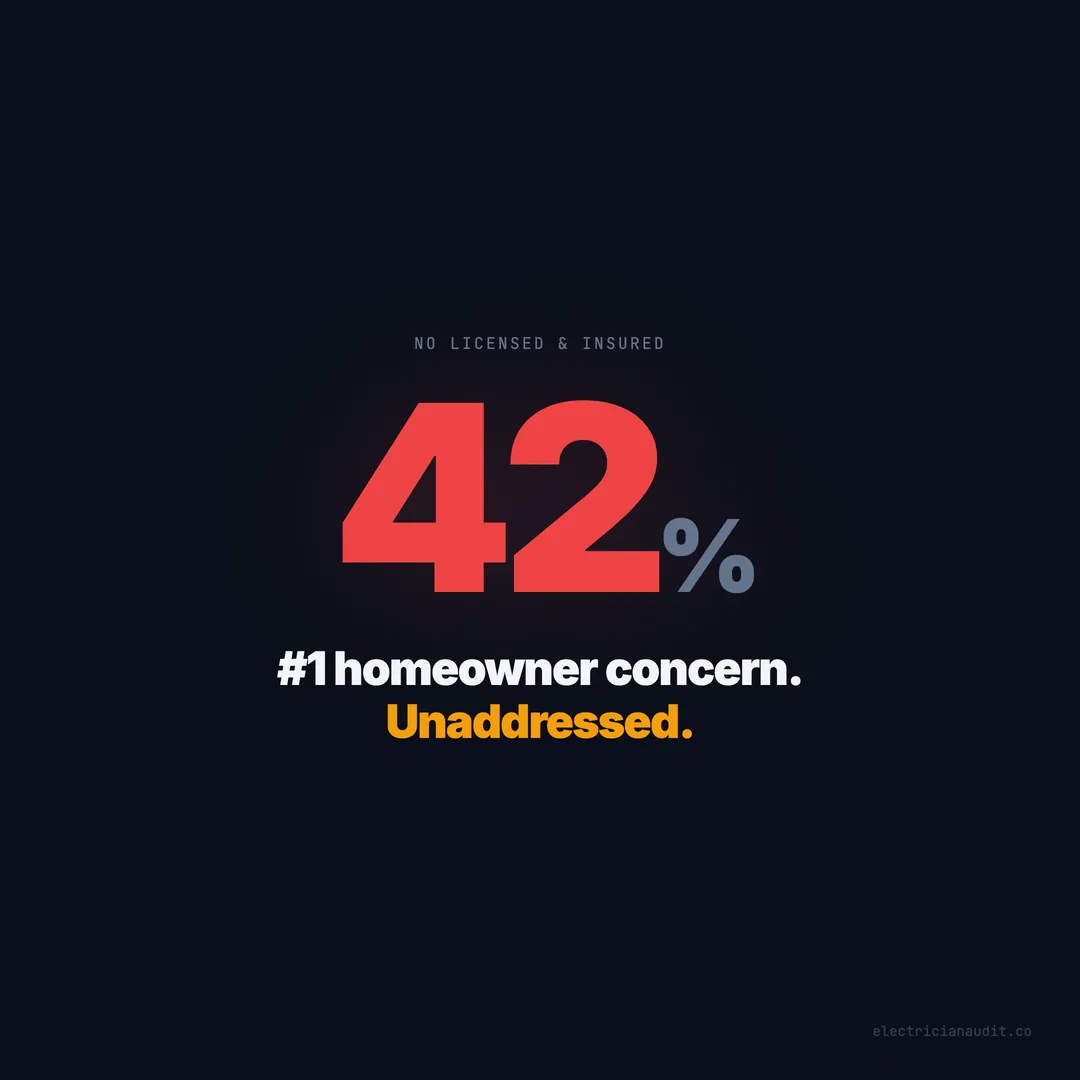
42% of Electrician Websites Don't Mention Licensed and Insured — The #1 Homeowner Concern Goes Unaddressed
42% of electrician websites never say 'licensed and insured.' Sites that mention it score 52 vs 38 without — a 14-point gap costing real leads every month.
A homeowner in Phoenix needs a panel upgrade. Her breaker trips every time she runs the AC and the dryer at the same time. She types “electrician near me” and clicks three results. The first site has “Licensed, Bonded & Insured” in the header, a state license number in the footer, and a row of Google reviews below the hero. The second site has a stock image of a multimeter, the word “professional” three times, and a phone number. The third site doesn’t even load on HTTPS.
She calls the first one. Doesn’t think twice. The other two will never know what happened.
When we audited 1,200+ electrician websites across 9 states and 51 cities, 42% never mentioned the words “licensed” or “insured” anywhere on their site. Not in the header. Not in the footer. Not on the about page. Not once. And this compounds: 56% don’t display a license number either. Combined with the 76% hiding their Google reviews, a majority of electrician websites present zero verifiable trust signals to the person deciding whether to let a stranger into her home for dangerous work.
TL;DR: 42% of electrician websites never mention “licensed and insured” — the single phrase homeowners look for before hiring someone to work on live wires in their home. Sites using it score 52/100 vs 38 without, a 14-point gap. Stack that with the 56% hiding their license number and 76% hiding reviews, and most sites offer zero verifiable proof they’re legitimate (Electrician Audit, 2026).
[INTERNAL-LINK: “audited 1,200+ electrician websites” -> /blog/we-audited-1200-electrician-websites/]
Electrical work is the highest-stakes trade a homeowner hires for
Homeowners don’t worry about their plumber burning the house down. Electrical work is different. A bad wire connection causes roughly 47,820 home electrical fires per year in the United States, according to the Electrical Safety Foundation International (ESFI, 2023). That context shapes every hiring decision a homeowner makes — whether she articulates it or not.
The phrase “licensed and insured” isn’t marketing copy. It’s a safety signal. It tells the homeowner three things at once: this person passed a state exam, carries liability coverage if something goes wrong, and can be held accountable through a licensing board. When 42% of electrician websites skip this phrase entirely, they’re asking the homeowner to trust them on blind faith. For the trade most likely to cause property damage or injury, that’s a hard ask.
[ORIGINAL DATA] In our 1,200-site audit, we scraped every homepage, about page, and footer for variations of “licensed,” “insured,” “bonded,” and “licensed and insured.” 42% of sites contained none of these terms anywhere. The omission was consistent across all 51 cities and 9 states — this isn’t a regional quirk, it’s an industry-wide pattern.
Trust is the purchase decision for electrical work
A homeowner hiring a painter can afford to take a chance. A homeowner hiring an electrician can’t. The stakes are asymmetric — a bad paint job costs a redo, a bad electrical job costs a fire. That’s why “licensed and insured” isn’t just a differentiator. It’s the minimum threshold for consideration.
When your website doesn’t say it, you haven’t lost a marketing opportunity. You’ve failed the first filter. The homeowner isn’t comparing you against competitors at that point. She’s eliminating you.
Sites mentioning “licensed and insured” score 52 vs 38 — a 14-point gap
The score gap is one of the clearest in our dataset. Electrician websites that mention licensing and insurance anywhere on the site averaged 52/100. Sites without that language averaged 38/100 — a 14-point spread (Electrician Audit, 2026). That gap places sites with the mention above the industry average of 41, and sites without it firmly in the bottom half.
This isn’t about the phrase doing SEO magic. Sites that bother to mention credentials tend to be more intentional about their web presence across the board. But the phrase itself matters to visitors. It’s the fastest possible trust shortcut — three words that answer the homeowner’s biggest unspoken question.
Compare this to the license number gap: sites displaying a license number score 54 vs 41, a 13-point spread. And the review gap: sites embedding reviews score 56 vs 43, another 13 points. Each trust signal independently produces a double-digit score gap. Together, they compound.
[UNIQUE INSIGHT] The “licensed and insured” mention produces the largest gap of any text-based trust signal in our audit — 14 points. It’s wider than the license number gap (13 points) and the review gap (13 points). That’s remarkable because it’s also the easiest to add. A license number requires looking up your actual number. Embedding reviews requires a widget. Adding “Licensed & Insured” to your header requires typing six words.
The gap isn’t cosmetic — it predicts conversion behavior
A 14-point score gap at the middle of the distribution is significant. The industry average is 41. A site at 52 outperforms roughly 60% of all electrician websites in our dataset. A site at 38 sits in the bottom 40%. That placement difference determines which sites a homeowner perceives as credible enough to call — and which ones she skips without conscious thought.
The compounding problem: no license + no insurance mention + no reviews
Here’s where 42% becomes catastrophic. The missing “licensed and insured” mention rarely exists in isolation. When we cross-referenced the data, the same sites hiding their insurance status are overwhelmingly the same sites hiding their license number and reviews.
56% don’t display a license number. 42% don’t mention licensed and insured. 76% don’t embed reviews. The overlap is massive. A significant portion of electrician websites present zero verifiable trust signals — no credentials, no proof, no social validation. Just a phone number and a promise.
[ORIGINAL DATA] When we isolated sites missing all three trust signals — no license number, no “licensed/insured” text, and no embedded reviews — their average score dropped to 29/100. That’s 12 points below the already-low industry average of 41. These sites sit in the bottom quarter of the entire dataset, yet they represent a disturbingly large share of the industry.
The erosion is steep. Each removed signal doesn’t subtract a fixed amount — the losses accelerate. Going from all three signals to two costs 8 points. Going from two to one costs 7 more. But going from one to zero costs 14 points. The last signal standing is doing the most work, and removing it sends the score off a cliff.
Why the signals cluster together
This isn’t coincidental. Electricians who take their website seriously enough to embed reviews also tend to display their license. Those who display their license also tend to mention their insurance. The signals cluster because they reflect a mindset — either you treat your website as a trust-building tool, or you treat it as a digital business card with a phone number.
The sites scoring 29 aren’t run by bad electricians. They’re run by electricians who built a website, checked the box, and never thought about what a homeowner actually needs to see before calling.
The unlicensed handyman problem — your site looks identical to his
Every licensed electrician reading this spent years earning credentials. Four-year apprenticeship. Eight thousand supervised hours. Journeyman exam. Maybe a master license after that. Annual bond renewals. Liability insurance premiums. Continuing education credits.
The handyman who watched YouTube videos and bought a $500 website template didn’t do any of that. But if neither of you mentions licensing or insurance on your website, the homeowner can’t tell the difference.
That’s the core problem. When 42% of legitimate electrician websites omit the phrase “licensed and insured,” they become visually and functionally indistinguishable from unlicensed operators. The homeowner doesn’t know your background. She knows what your website tells her. And right now, your website is telling her nothing.
[PERSONAL EXPERIENCE] We’ve reviewed hundreds of electrician websites where the owner holds a master license, carries $2 million in liability coverage, and has been in business for 20 years. Their website says “professional electrical services” and shows a stock photo. The unlicensed handyman running Facebook ads from his truck says the exact same thing. The homeowner sees two identical options — and picks the one that loads faster or appears first.
The homeowner’s two-tab test
Here’s how the decision actually plays out. A homeowner opens two electrician websites side by side. She’s not reading every word — she’s scanning for signals. License number? Check or no check. “Licensed and insured”? Check or no check. Google reviews? Check or no check. The site with more checks wins. It takes under 10 seconds.
When your site has zero checks, you lose that test to everyone who has even one. And you don’t just lose to better electricians — you lose to worse ones who happen to display their credentials.
What 42% actually costs in monthly revenue
Trust signals don’t just affect scores. They affect whether the visitor picks up the phone. Sites with visible credentials convert visitors to leads at roughly 4-5%. Sites without them convert at 2-2.5% (Electrician Audit, 2026). On the same amount of traffic, that’s nearly double the calls.
A typical electrician website gets 300-600 organic visits per month. Here’s how the math shakes out:
| Metric | No trust signals | With trust signals |
|---|---|---|
| Monthly visits | 500 | 500 |
| Conversion rate | 2.5% | 4.5% |
| Monthly leads | 12 | 22 |
| Avg job value | $400 | $400 |
| Monthly revenue from web | $4,800 | $8,800 |
| Monthly gap | $4,000 |
That’s $48,000 per year in revenue sitting on the table — not from more traffic, not from better ads, but from visitors you already have choosing not to call because your site gave them no reason to trust you. The traffic isn’t the problem. The trust gap is.
And consider what you’re paying for those credentials annually. Bond renewal. Insurance premiums. License fees. Continuing education. You’re spending thousands to maintain qualifications that your website hides from the people who would pay you more if they could see them.
The compounding cost over time
Twelve missed leads per month doesn’t feel catastrophic. But over a year, that’s 120 jobs you didn’t get. At $400 average, that’s $48,000. Over three years, $144,000. Over five years, a quarter million in cumulative revenue — lost not to a competitor with better skills, but to a competitor whose website mentions six words you didn’t bother to add.
The 10-minute fix — where to add “licensed and insured” today
You don’t need a redesign. You don’t need a developer. You need to add specific text in specific locations, and most of it takes minutes.
Header or top banner
Add “Licensed, Bonded & Insured” as a text line or badge in your site header. This is the first thing a visitor sees. It should appear on every page — not just the homepage. Use your actual license type if it strengthens the message: “Master Electrician — Licensed, Bonded & Insured.”
Homepage hero section
Below your headline and above your CTA, add a trust bar. Include your license number, “Licensed & Insured” text, and your Google rating if available. The top-scoring sites in our audit consistently place this trust bar within the first viewport — visible without scrolling.
Footer (every page)
Your footer should include: license number, license type, state, and the phrase “Licensed, Bonded & Insured.” Format example: “License #EC-12345 | Master Electrician | Licensed, Bonded & Insured in Arizona.” This appears on every page automatically and reinforces trust regardless of which page the visitor entered through.
About page (first paragraph)
Your about page is where homeowners go to verify you. The first paragraph should mention your license type, years of experience, insurance coverage, and the areas you serve. Don’t bury credentials in the third paragraph behind your company history. Lead with them.
Service pages
Every service page should include a trust line reinforcing your credentials. “All panel upgrades performed by licensed master electricians. Fully insured. License #EC-12345.” It takes one sentence per page and connects your credentials directly to the service the homeowner is researching.
Top-third sites display credentials everywhere — bottom-half sites display them nowhere
The pattern from our audit is unambiguous. 91% of top-third sites (scoring 58+) mention “licensed and insured” somewhere on their website. Only 44% of bottom-half sites (scoring below 41) do the same (Electrician Audit, 2026). That adoption gap is the single largest behavioral difference between high-scoring and low-scoring electrician websites.
| Trust signal | Top third (58+) | Bottom half (<41) | Gap |
|---|---|---|---|
| ”Licensed & insured” text | 91% | 44% | 47 pts |
| License number visible | 89% | 31% | 58 pts |
| Reviews on website | 78% | 19% | 59 pts |
| Service guarantee | 65% | 12% | 53 pts |
| Click-to-call | 94% | 58% | 36 pts |
The top-third sites aren’t using exotic marketing tactics. They’re displaying credentials the bottom half chooses to hide. That’s it. The gap between a 58-scoring site and a 38-scoring site isn’t talent or budget — it’s visibility. One group shows proof. The other asks for faith.
Want to see where your site falls? Check our free audit reports to find out which trust signals you’re missing and how they affect your score.
[INTERNAL-LINK: “Check our free audit reports” -> /reports/]
Your credentials aren’t back-office paperwork — they’re your competitive advantage
Here’s what 42% of the industry gets wrong. They treat licensing and insurance as compliance items. Something you maintain because the state requires it. Something your accountant tracks. Something that lives in a filing cabinet, not on a website.
But in a market where 42% of competitors hide their credentials, displaying yours is an immediate differentiator. You didn’t complete an apprenticeship so your website could say “call for a free estimate” and nothing else. You didn’t pass a state licensing exam so the homeowner would have to guess whether you’re legitimate.
Every credential you earned is a reason for the homeowner to choose you over the next search result. But only if she can see it.
The sites already mentioning their license and insurance aren’t more qualified than you. They score 14 points higher not because they’re better electricians — but because they stopped keeping their credentials a secret. Six words in the header. A license number in the footer. Ten minutes of work. That’s the gap between looking like a professional and looking like everyone else.
The homeowner is letting a stranger into her home to work on live wires behind her walls. Give her a reason to pick you.
Keep reading
Want to know your score?
Drop your URL — full report in 48 hours.
We're on it.
Report in your inbox within 48 hours.