75% of Electrician Websites Have No Lighting Installation Page
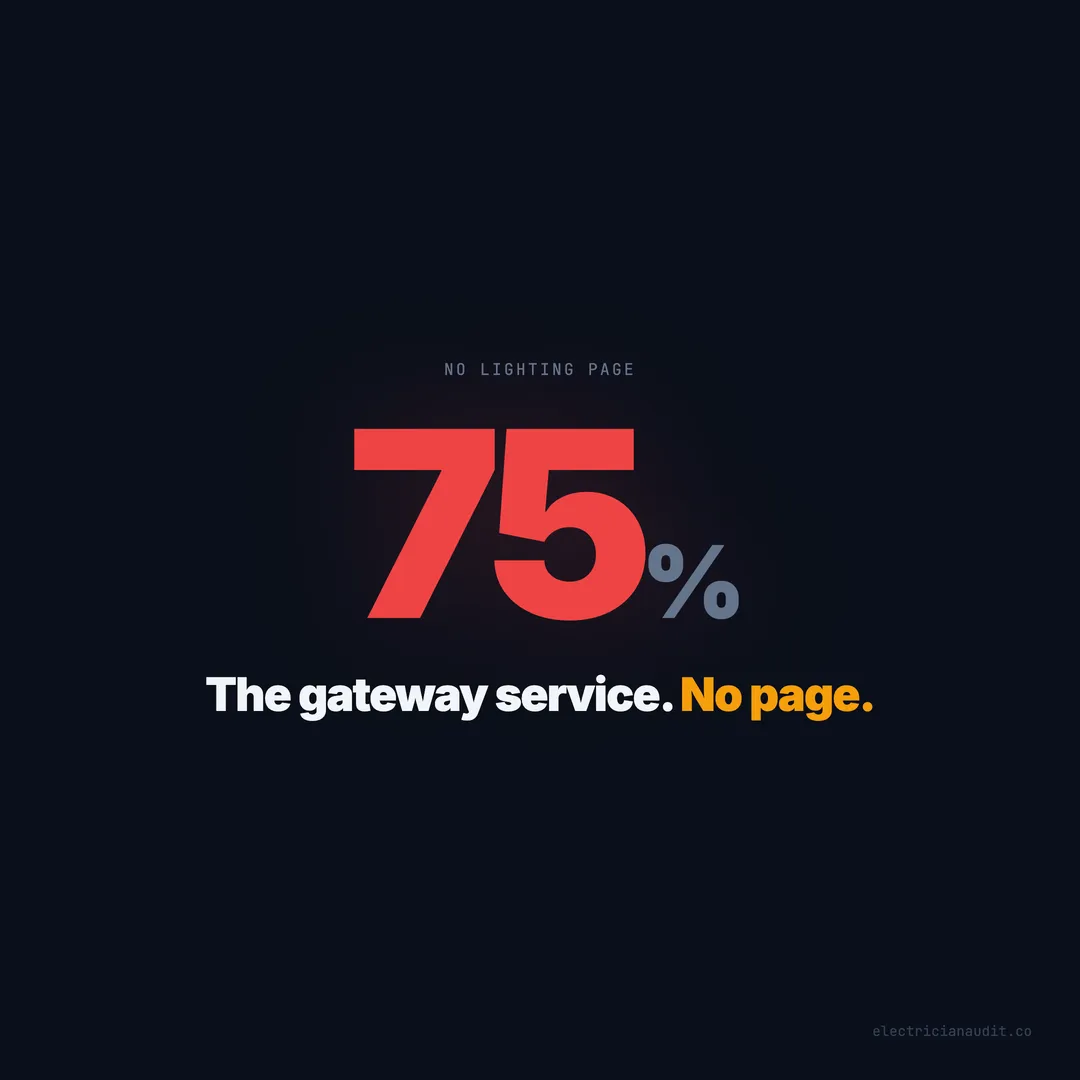
946 of 1,259 audited electrician sites have no lighting page. That's 75% invisible for recessed, outdoor, and smart lighting — the gateway to panel upgrades and rewires.
A homeowner just finished a kitchen remodel. The contractor left, the countertops are in, and now the room feels dark. She wants recessed lighting — six cans, maybe a dimmer switch. She picks up her phone and searches “recessed lighting installation near me.”
Your company does this work every week. You’ve wired hundreds of kitchens. But your website doesn’t mention lighting anywhere. Not in the nav, not on a services page, not in a single blog post. Three competitors show up instead. She calls the first one. That job pays $800. And it would have led to a panel conversation you’ll never have.
When we audited 1,259 electrician websites across 9 states, 946 had no dedicated lighting installation page. That’s 75%. Another 945 had no outdoor or landscape lighting page either. Recessed lighting, outdoor lighting, smart lighting — three distinct search queries, three distinct customer needs, and virtually zero pages competing for them.
Lighting isn’t just another service. It’s the most common entry point for residential electrical work. And 75% of electricians aren’t showing up for it.
946 Out of 1,259 Electrician Websites Have No Lighting Page
Out of 1,259 deep-audited electrician sites across 9 states and 51 cities, 946 have no dedicated lighting installation page — a 75% gap. That makes lighting the sixth-most-missing service page in our dataset, behind surge protection (94%), solar (93%), smoke detectors (88%), emergency services (84%), and rewiring (81%).
But here’s what separates lighting from those other gaps. Lighting searches happen constantly, across every season, in every market. Nobody searches “surge protector installation” on a Tuesday afternoon because their living room feels dim. People DO search “recessed lighting installer” or “outdoor lighting electrician” every single day.
[ORIGINAL DATA] When we mapped the overlap between missing lighting pages and missing outdoor lighting pages, the numbers were nearly identical: 946 and 945 respectively. That’s not a coincidence. It means the same electricians ignoring indoor lighting are also ignoring outdoor lighting. They’ve written off the entire category — and left two separate search queries on the table.
The average electrician website in our dataset scores 41 out of 100. Sites that have dedicated pages for at least 6 services average 58. A lighting page won’t fix a broken site. But its absence is a reliable marker of a site that isn’t trying.
The search volume is steady, not seasonal
Unlike generator installations that spike during hurricane season or EV charger demand tied to vehicle purchases, lighting searches run year-round. Kitchen remodels happen in January. Patio projects happen in June. Holiday lighting consultations start in September. A lighting page works twelve months a year because homeowners think about lighting twelve months a year.
Lighting Is the Gateway Service to Bigger Electrical Jobs
A recessed lighting job averages $800 to $2,000 depending on the number of fixtures and existing wiring. That’s decent work on its own. But the real value of a lighting customer isn’t the lighting job — it’s what comes next. In our experience reviewing hundreds of electrician sites and the services they promote, lighting is the single most reliable lead-in to larger projects.
Here’s the typical sequence. An electrician installs six recessed lights in a kitchen. While they’re in the attic, they notice the panel is a 100-amp Federal Pacific from 1987. They mention it to the homeowner. Three months later, that homeowner calls back for a $2,000 to $4,000 panel upgrade. A year later, they want the whole house rewired because the inspection revealed aluminum wiring.
That one lighting call turned into $8,000+ in total work. And it started because a homeowner searched “recessed lighting installation” and found an electrician with a page for it.
[UNIQUE INSIGHT] We’ve noticed a pattern across our dataset that nobody talks about. The service pages that seem “small” — lighting, ceiling fans, outlet installation — are the ones that create repeat customers. The “big” pages like generators and EV chargers bring one-time buyers. Lighting brings a relationship. And 75% of electrician sites aren’t even starting that relationship because they have no page for it.
Panel upgrades hide inside lighting jobs
How often does a lighting installation reveal a panel problem? More often than most electricians realize from their marketing. Every time you add circuits for recessed lighting, you’re evaluating the panel’s capacity. Older homes with 100-amp service frequently can’t support additional lighting circuits without an upgrade.
Yet 66% of electrician websites have no panel upgrade page either. So even when the lighting job triggers the upsell, there’s no page to link the homeowner to. No content explaining why their panel needs replacing. No pricing context. Nothing to keep them on your site instead of Googling “panel upgrade electrician” and finding someone else.
Rewiring follows the same path
The same pattern applies to rewiring. A lighting installation in a 1970s home often uncovers knob-and-tube wiring, aluminum branch circuits, or deteriorating insulation. That discovery leads to a rewiring conversation worth $8,000 to $15,000+. But 81% of electrician websites have no rewiring page. The customer who found you through lighting leaves your site to find a rewiring specialist — who might not even be as qualified as you.
Three Lighting Searches, Zero Pages From Most Electricians
Homeowners don’t search “lighting.” They search specific types. And each type represents a different project, a different budget, and a different page your competitors don’t have.
Recessed lighting installation — the most common indoor lighting search. Kitchen remodels, living room upgrades, basement finishes. Average job: $800 to $2,000. The homeowner knows what they want. They need someone who can cut the holes, run the wire, and connect to the panel without burning down the house.
Outdoor and landscape lighting — patios, decks, pathways, security floodlights, holiday-ready outlets. These projects run $2,000 to $5,000+ for full landscape lighting designs. They require weatherproof wiring, GFCI protection, and often a dedicated circuit. And 945 out of 1,259 electrician sites have no page for any of it.
Smart lighting installation — Lutron, Philips Hue hardwired systems, whole-home dimming. This is newer demand, growing fast with smart home adoption. The homeowners searching for this tend to be higher-income, tech-savvy, and willing to pay for professional installation. They’re also exactly the kind of customer who’ll need a panel evaluation, a dedicated home automation circuit, or a full smart home wiring plan.
Each of these is a distinct search query. Each one has commercial intent. And each one returns results from the small minority of electricians who bothered to build a page.
Why a generic “Services” page doesn’t capture these searches
Somebody searching “outdoor lighting installation Phoenix” isn’t going to find your site if your only mention of lighting is a bullet point on a page titled “Our Electrical Services.” Google needs a page that matches the query. A bullet point is not a page. It’s not indexable as a standalone topic. It carries no heading structure, no internal links, no supporting content.
The sites that rank for specific lighting queries have pages with that service in the URL, the H1, and at least 400-600 words of content describing the work. This isn’t complicated. But it does require building the page — something 75% of electricians haven’t done.
Missing Lighting Pages Compound With Every Other Gap
The lighting page gap doesn’t exist in isolation. It stacks with every other missing page to create a site that’s invisible across entire categories of work. Here’s how the gaps overlap in our dataset:
| Missing Page | Sites | % of 1,259 |
|---|---|---|
| Surge protection | 1,184 | 94% |
| Rewiring | 1,020 | 81% |
| Lighting installation | 946 | 75% |
| Outdoor lighting | 945 | 75% |
| Panel upgrade | 826 | 66% |
| Generator | 783 | 63% |
| EV charger | 770 | 62% |
[ORIGINAL DATA] When we cross-referenced these gaps, a clear pattern emerged. The average electrician website in our dataset is missing pages for 5+ core services simultaneously. That means a typical site isn’t just invisible for lighting. It’s invisible for lighting AND rewiring AND panel upgrades AND outdoor lighting AND surge protection — all at once.
A homeowner who finds you for recessed lighting should be able to click through to your panel upgrade page, your rewiring page, and your outdoor lighting page. That internal linking structure keeps them on your site and builds trust. Without those pages, every visit is a dead end.
The compounding effect on site quality scores
We’ve seen this pattern clearly in the data. Electricians who have dedicated pages for at least 6 services score an average of 58 out of 100. Those without? They sit at the dataset average of 41. That 17-point difference reflects the compounding reality: each missing page makes every other page less effective. No internal links. No topical authority. No reason for Google to treat your site as a comprehensive electrical resource.
Sites in the top 1.9% (scoring above 80) almost always have lighting pages. Not because lighting is a magic ranking factor. Because the kind of electrician who builds a lighting page also builds panel upgrade pages, service area pages, and emergency pages. Comprehensive sites win. Thin sites don’t.
The Revenue You’re Missing Isn’t Just the Lighting Job
Let’s run the numbers on what a missing lighting page costs over 12 months. Not best-case. Conservative.
Assume you miss 2 lighting jobs per month because you have no page. Average ticket: $1,200 (a mix of basic fixture swaps at $400 and recessed lighting projects at $2,000). That’s $2,400/month, or $28,800/year in lighting work alone.
Now factor in the gateway effect. Of those 24 missed lighting customers per year, maybe 4-6 would have needed a panel upgrade ($2,000-$4,000 each). Maybe 1-2 would have led to a rewiring conversation ($8,000-$15,000). Conservatively, that’s another $15,000 to $30,000 in downstream work.
Total missed revenue from one missing page: $43,000 to $58,000 per year.
And that’s before outdoor lighting. A few landscape lighting projects at $3,000-$5,000 each add another $15,000+ annually. Smart lighting installations add more. Every variant of lighting work you don’t have a page for is a variant of customer you’re not reaching.
[PERSONAL EXPERIENCE] We’ve reviewed sites where an electrician clearly does excellent lighting work — they’ve got photos of gorgeous kitchen remodels in their gallery. But there’s no lighting page. The photos sit on a generic portfolio page with no context, no service description, no way for Google to connect “recessed lighting installation” to that gallery. The work exists. The marketing doesn’t.
What a Lighting Page Needs to Rank and Convert
Building a lighting installation page isn’t a major project. It’s one page with specific content that matches what homeowners actually search for. Here’s the baseline that works.
Page structure
- URL:
/lighting-installation/or/recessed-lighting-installation/ - H1: Include “lighting installation” + your city — “Recessed Lighting Installation in [City]”
- Content: 600-800 words covering types of lighting you install, process, and pricing ranges
- Photos: Before/after shots of actual jobs. Nothing sells lighting work like lighting work
- Call-to-action: Click-to-call button and a short request form above the fold
Content that matters
Describe the types of lighting you handle: recessed, under-cabinet, pendant, track, outdoor, landscape, security, smart. For each type, give a sentence or two about what’s involved and a rough price range. Homeowners searching for lighting want to know three things: can you do it, what does it cost, and how do I contact you?
Mention panel capacity when relevant. If a home needs more than 4-6 new recessed lights, there’s a good chance the panel needs evaluation. Link to your panel upgrade page — assuming you have one (66% of your competitors don’t).
Internal links that build topical authority
Your lighting page should link to panel upgrades, rewiring, service area pages, and outdoor lighting. Each cross-link tells Google your site covers the full scope of residential electrical work. The electricians scoring in the top tier of our dataset have this kind of interconnected structure. The ones at 41/100 have orphaned pages — if they have pages at all.
Your Competitors Still Haven’t Built This Page
Here’s the opportunity in one sentence: 75% of electrician websites have no lighting page, which means 75% of your competitors are invisible for the most common residential electrical search category.
The bar is remarkably low. You don’t need a beautiful, custom-designed page. You need a page that exists. One that has “lighting installation” in the URL, the heading, and the body text. One that describes what you do, shows what you’ve done, and makes it easy to call you. That’s enough to rank above three-quarters of the market.
And unlike paid ads — which 24% of electricians are running at an average of $15-25 per click — a lighting page costs nothing after you build it. It ranks. It generates calls. It introduces homeowners to your other services. It starts a relationship that leads to panel upgrades, rewiring, outdoor lighting, and smart home work.
The electricians who already have lighting pages are also the ones with service area pages, emergency pages, and complete service catalogs. They’re pulling ahead. The 75% without a lighting page are falling behind in a way that compounds every month.
One page. A few hours of work. And you become visible for the search query that starts more residential electrical relationships than any other.
Check how your site compares in your market.
Keep reading:
Want to know your score?
Drop your URL — full report in 48 hours.
We're on it.
Report in your inbox within 48 hours.