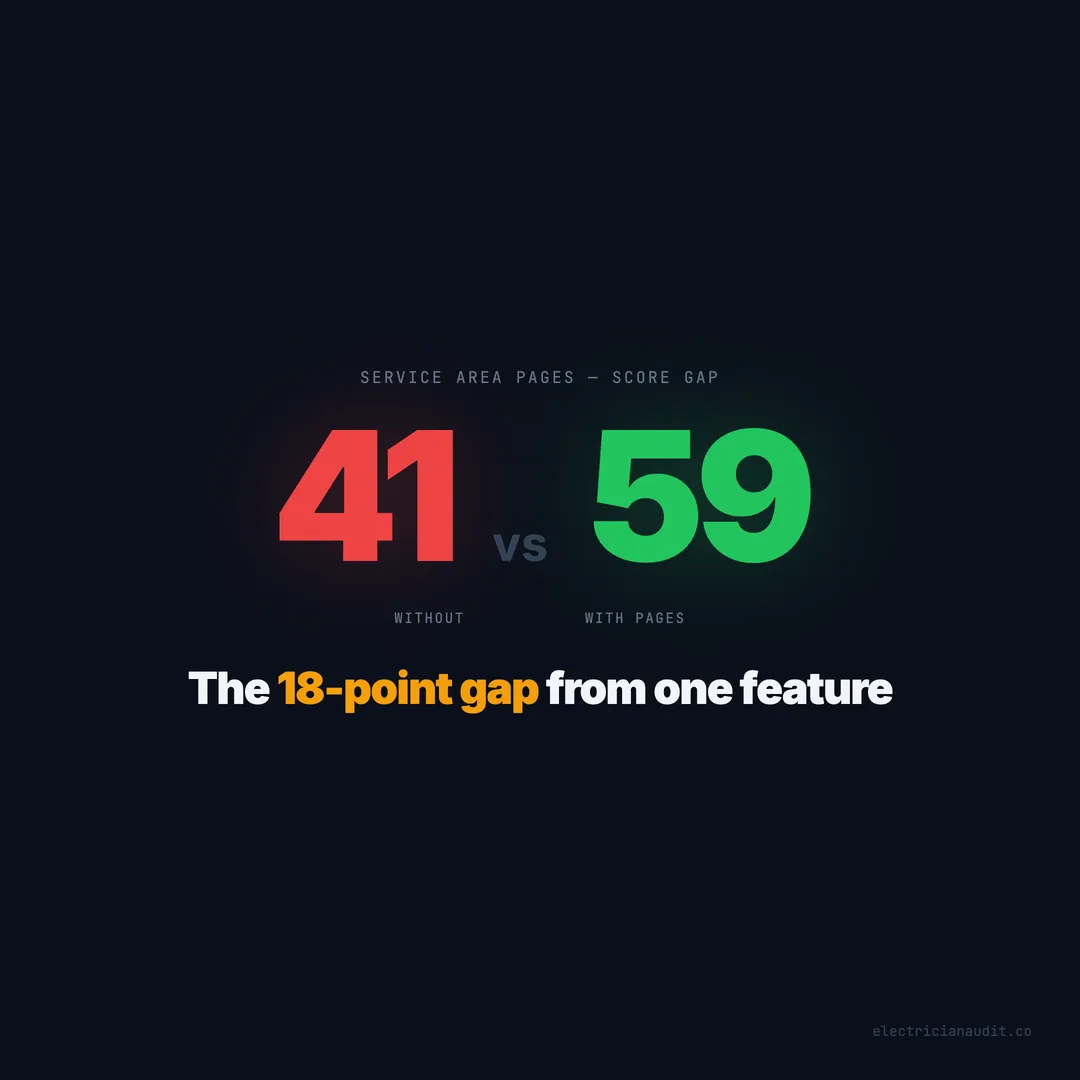
The 18-Point Gap: Electricians With Service Area Pages Score 59. Without: 41.
70% of electrician websites have no service area pages. Those that do score 59/100 — an 18-point gap, the largest single-feature difference in 1,200+ audits.
A homeowner in Katy, Texas searches “electrician in Katy” at 9 PM on a Tuesday. Her kitchen outlet sparked and she can’t use half the counter. Google shows three results — all electricians with dedicated Katy pages on their websites. Your company is 12 minutes away. You’ve done 200+ jobs in Katy. But you don’t show up because your website says “Serving the Greater Houston Area” and nothing else.
This plays out thousands of times a day across every suburb in every metro we studied. When we audited 1,200+ electrician websites across 9 states, 70% had zero service area pages. Not weak pages. Not thin pages. Nothing. And the gap between those who built them and those who didn’t was the largest single-feature gap in the entire dataset: 18 points (59 vs 41 out of 100).
That’s not a minor edge. It’s the difference between a website that generates calls and one that exists only for people who already have your number. The search results in your secondary markets aren’t empty — they’re filled by the electrician who spent $200 on a page you never built.
70% of electrician websites have zero service area pages
The number is worth repeating because it means the majority of electricians in our dataset are invisible in every city except maybe their home base. Out of 1,259 deep-audited sites across 51 cities, 882 had no dedicated service area pages at all. No city pages, no neighborhood pages, no suburb-specific landing pages. Just a single homepage and maybe an “Areas We Serve” bullet list buried in the footer.
What makes this worse is the search volume sitting behind these missing pages. “Electrician near me” pulls 230,000+ monthly searches nationally. But “near me” is just the umbrella. The real volume lives in city-specific queries — “electrician in Katy TX,” “emergency electrician Chandler AZ,” “panel upgrade Charlotte NC.” Each of those queries has its own search results, its own competition, and its own winner.
Without a page targeting that city, you can’t be that winner. Google doesn’t guess your service area from a bullet list. It needs a dedicated, crawlable page to understand that you serve Katy, or Chandler, or Charlotte. The 70% of electricians without these pages have forfeited those results to the 30% who built them.
[ORIGINAL DATA] When we segmented our 1,200+ audit dataset by the presence of service area pages, the gap was immediate and dramatic. Sites with even a handful of city pages scored 18 points higher on average — a wider margin than any other single website feature we measured.
The 18-point gap is the largest single-feature difference we found
We measured the score impact of every major website feature across 1,200+ electrician sites. Click-to-call presence, online booking, HTTPS, license display, review integration, after-hours capture — all of them. Service area pages produced the widest gap: 59 vs 41, an 18-point spread. Nothing else came close except click-to-call at 20 points (52 vs 32).
Here’s the comparison against every other feature gap we measured:
| Feature Present | Avg Score With | Avg Score Without | Gap |
|---|---|---|---|
| Click-to-call | 52 | 32 | +20 |
| Service area pages | 59 | 41 | +18 |
| Online booking | 55 | 39 | +16 |
| After-hours capture | 57 | 41 | +16 |
| License displayed | 54 | 41 | +13 |
| Reviews on site | 56 | 43 | +13 |
| SSL + form + CTA combo | 55 | 43 | +12 |
Online booking gets more attention. SSL certificates get more panic. But service area pages quietly produce a bigger score difference than either of them. The electricians scoring 59 aren’t doing everything right — they still have plenty of room to improve. But they’ve crossed a visibility threshold that the 41-scoring majority hasn’t.
Why does this single feature carry so much weight? Because service area pages are a proxy for intentionality. An electrician who built city pages also tends to have better site structure, clearer service descriptions, and more internal linking. The pages themselves improve the score, and the mindset behind building them improves everything else.
Search results aren’t empty — they’re filled by competitors who built these pages
Here’s the part that makes this painful. When someone searches “electrician in [suburb]” and you don’t have a page for that suburb, Google doesn’t show a blank screen. It shows every competitor who did build that page. Your absence isn’t neutral. It’s an active loss to someone who spent a few hundred dollars on content you skipped.
We see this pattern across every market we’ve studied. Take Houston — the largest metro in our dataset with 463 audited sites. Katy, TX electricians average a 61 score. Many of them built dedicated pages for surrounding suburbs: Fulshear, Cypress, Richmond, Sugar Land. The Houston-based electricians serving those same areas but running a single homepage? They don’t appear in those searches at all.
The same story repeats in Charlotte (average score 59), Jacksonville (average score 66), and Scottsdale (top score in our dataset at 66). The high-scoring cities consistently have more electricians with dedicated service area pages. It’s not coincidence. It’s cause and effect.
And it gets worse by state. North Carolina leads our dataset with an average score of 52. Louisiana sits last at 39. The spread between the best and worst state is 13 points — and service area page adoption is one of the clearest differentiators. NC electricians are more likely to have city pages. LA electricians are more likely to have a single-page website.
The money math behind missing city pages
Let’s make this concrete. Suppose you serve 10 suburbs around your home base. Each suburb generates, conservatively, 200-500 monthly searches for electrician-related queries. Without city pages, you’re invisible for roughly 2,000-5,000 searches per month.
Even with modest assumptions — a 3-5% click-through rate on organic results, and a 2-3% conversion rate from visitor to lead — the math gets uncomfortable fast.
| Metric | Conservative | Moderate |
|---|---|---|
| Cities served (no pages) | 10 | 10 |
| Monthly searches per city | 200 | 500 |
| Total missed searches | 2,000 | 5,000 |
| CTR if you ranked | 3% | 5% |
| Monthly visitors lost | 60 | 250 |
| Conversion rate | 2% | 3% |
| Leads lost per month | 1-2 | 7-8 |
| Avg job value | $350 | $500 |
| Monthly revenue lost | $350-700 | $3,500-4,000 |
[UNIQUE INSIGHT] Those 1-8 lost leads per month don’t show up in any dashboard. You can’t measure what you never captured. There’s no “missed search” report in Google Analytics. These leads quietly go to the competitor who built a $200 page — and you never know they existed. That’s what makes service area gaps so dangerous. The loss is invisible until you close it and suddenly start getting calls from suburbs you thought were dead.
The electrician in Houston running Google Ads at $15-25 per click to reach surrounding suburbs is paying $450-750/month for traffic that a set of city pages would deliver for free after the initial build cost. 84% of electricians in our dataset have no online booking — so even the ones paying for ads are sending that traffic to a homepage with no clear conversion path. The waste compounds.
Only 1.9% of electrician websites score above 80
The 18-point gap from service area pages matters even more when you see how low the bar actually sits. Out of 1,390 electrician websites we audited, only 26 scored above 80. That’s 1.9%. The vast majority cluster between 30 and 50 — a range where basic features are missing and organic visibility is minimal.
What does a score of 41 actually look like? It’s typically a site with a homepage, maybe a services page, no city pages, no blog, no schema markup, and either no form or a form buried on a contact page. It might load. It might even look decent. But it’s not generating leads because it doesn’t give Google or homeowners any reason to choose it over the dozen competitors in the same search results.
95% of electrician websites have no LocalBusiness schema. That means Google has to guess what you do, where you do it, and whether you’re even a real business. Combine that with the 70% missing service area pages and 60% without a blog, and you start to see why the average score is 41. Most electrician websites are technically online but functionally invisible.
The 30% who built service area pages scored 59 on average. Still not great — but they’ve cleared the threshold where Google treats them as relevant for local queries. That 18-point jump doesn’t just look good on a scorecard. It translates directly into appearing in search results where the 41-scoring majority doesn’t.
What goes on a service area page that actually ranks
This isn’t a full tutorial — we’ll cover the step-by-step build in a dedicated guide. But you should understand what separates a page that ranks from one Google ignores. The difference is specificity.
A bad city page swaps the city name in a template and changes nothing else. “We provide electrical services in [City]” repeated 15 different times with only the city name changed. Google’s helpful content system flags these as thin content. They don’t rank, and they can drag your entire site down.
A good city page includes five elements:
Local housing and electrical context
Reference the housing stock in that city. Homes built in the 1970s-80s often have aluminum wiring or Federal Pacific panels. Newer subdivisions from the 2010s have higher electrical loads from smart home systems and EV chargers. This local knowledge signals expertise.
Neighborhoods and zip codes
Naming specific neighborhoods tells Google this page is genuinely about that city. “We serve West University Place, Meyerland, Bellaire, and the Heights” is far more specific than “Serving the Houston area.”
Services relevant to that area
Not just a generic list. If the area has frequent storm damage, lead with surge protection and generator installation. If it’s new construction, lead with panel upgrades and EV charger installation. 94% of electrician sites have no surge protection page and 62% have no generator page — so your city page can fill gaps your competitors aren’t covering either.
Social proof from that city
A review from a customer in Katy carries more weight on your Katy page than a generic review from across town. It tells the homeowner “they actually work here” in a way that no amount of copy can replicate.
A clear conversion path
Click-to-call above the fold. A short form that asks what’s wrong and where they’re located. 53% of electrician websites have no contact form at all — so if your city page has a working form with a phone number, you’re already ahead of half the market.
[PERSONAL EXPERIENCE] When we’ve seen electricians add even 5 city pages with these elements, their visibility in secondary markets changed within weeks. Not months. Google indexes well-structured local content fast because there’s so little competition for it in most electrical markets. The 70% with nothing are leaving the door wide open.
State-by-state: where service area pages matter most
The impact of service area pages isn’t uniform. It depends on how competitive your state market is and how poorly your local competitors have built their sites.
North Carolina (avg 52) has the strongest electrician websites in our dataset. Charlotte scores 59 and Raleigh isn’t far behind. These markets have more electricians building dedicated city pages, more schema markup adoption, and more complete site structures. If you’re an electrician in NC without city pages, you’re competing against a higher baseline.
Louisiana (avg 39) sits at the bottom. The bar is lower, which means the opportunity is wider. An electrician in Baton Rouge or New Orleans who builds 5-10 city pages could leapfrog dozens of competitors overnight. When the average competitor scores 39, getting to 59 doesn’t require perfection. It requires showing up.
Texas (avg 45) has the most volume — 463 sites in our dataset. But the averages hide massive city-level variation. Katy averages 61 while El Paso averages 31. Dallas sits in the middle. The metros where electricians have built city pages consistently outscore those where nobody has.
Service area pages are the highest-ROI fix on this list
Consider the alternatives. Online booking systems cost $50-200/month in software fees and require ongoing maintenance. Running Google Ads in 10 suburbs costs $500-2,500/month indefinitely. Hiring an SEO agency runs $1,500-5,000/month with uncertain timelines. Service area pages cost $100-300 each to build (or a few hours of your time) and they work permanently once indexed.
The math is straightforward. Ten city pages at $200 each = $2,000 one-time cost. If those pages collectively generate even 3-4 extra leads per month at a $400 average job value, they’ve paid for themselves in less than two months. Everything after that is pure margin.
And unlike ads, these pages don’t stop working when you stop paying. Electricians running ads spend an average of $15-25 per click in competitive markets. At 20 clicks to generate one lead, that’s $300-500 per lead from ads. A city page that generates one lead per month delivers the same value for $0 in ongoing cost after the initial build.
We’ve watched this pattern across our full national dataset. The electricians who invest in content — city pages, service pages, blog posts — build compounding visibility. The ones who rely solely on ads are renting their leads month to month and vulnerable the instant they cut budget.
The competitors already building these pages aren’t stopping
Here’s the uncomfortable truth. 24% of electricians in our dataset are running paid ads. Those companies average a score of 64 — well above the 40 average of non-advertisers. They’re investing in their online presence already, and many of them are also building city pages. They’re pulling further ahead while the 70% without service area pages sit still.
Sites with 100+ Google reviews average a score of 61. Sites with under 20 reviews average 30. The companies investing in reviews are the same ones investing in city pages, schema markup, and site structure. Success compounds. Neglect compounds too — just in the wrong direction.
The market research across all 51 cities makes it clear. The gap between high-performing and low-performing electrician websites isn’t about budget or technology. It’s about whether someone sat down and built the pages. The 30% who did are capturing leads in markets the 70% have abandoned.
You serve 10 or 15 cities. Your website mentions one. Search results aren’t empty in those other 14 cities — they’re showing the electrician who built a page for each one.
Start with your highest-revenue suburb. Build one page this week. Then the next. Ten pages from now, the 18-point gap won’t be something you’re reading about. It’ll be something you’ve closed.
The search results in your service area are filling up right now. The only question is whether your name is in them — or whether you’re the one losing leads to someone who showed up.
Keep reading
Want to know your score?
Drop your URL — full report in 48 hours.
We're on it.
Report in your inbox within 48 hours.