How to Display Google Reviews on Your Electrician Website (Free + Paid Options)
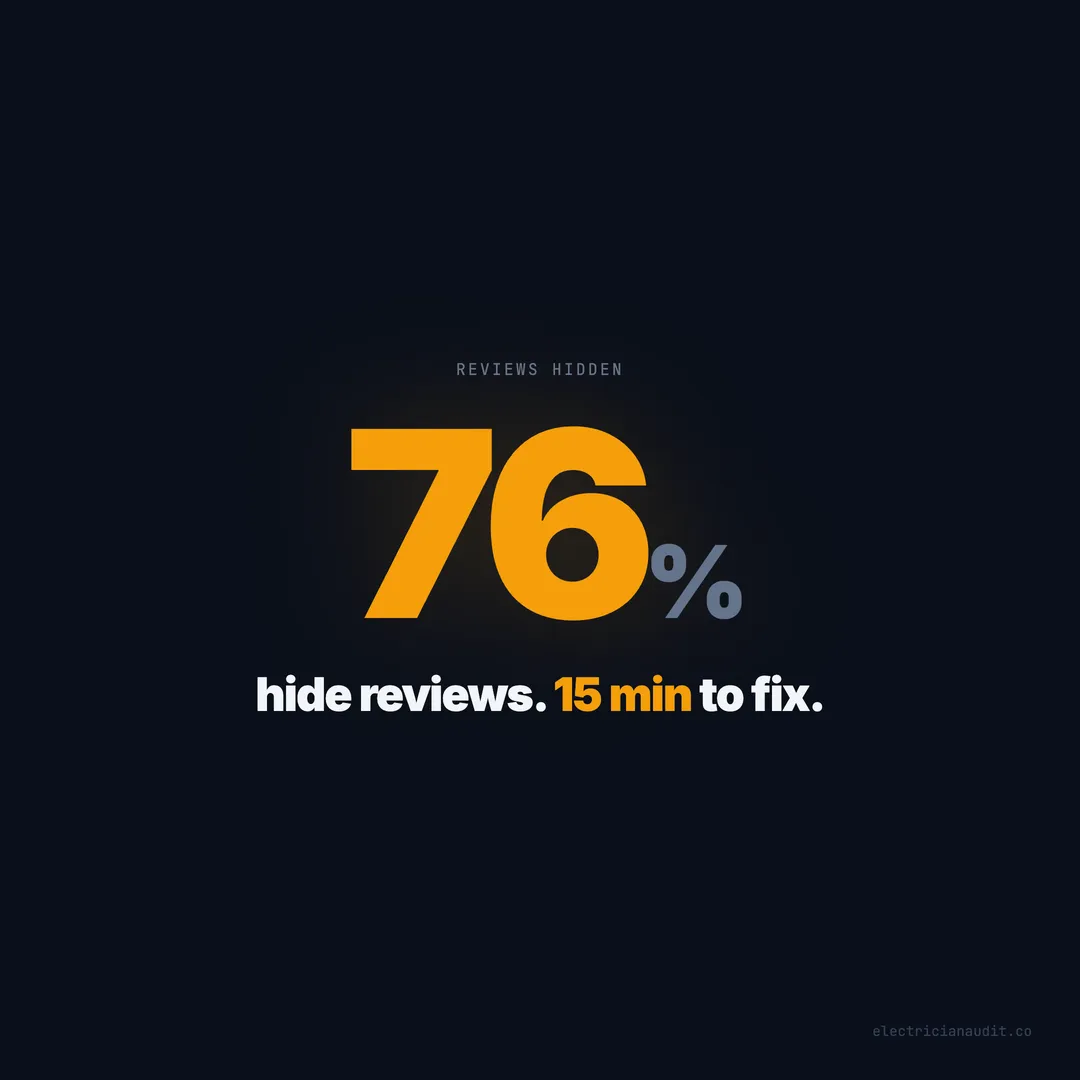
76% of electrician sites hide their reviews. Here's how to embed them in under 15 minutes — free and paid options, placement strategy, and the 13-point score gap.
You have a 4.78-star Google rating. You earned it over years of clean panel work, on-time arrivals, and homeowners who genuinely trust you. But when someone clicks your Google Ad or a referral link, they don’t land on your Google Business Profile. They land on your website. And right now, your website probably doesn’t show any of it.
When we audited 1,200+ electrician websites across 9 states, 76% didn’t display a single review on their site (electricianaudit.co, 2026). The average industry rating was 4.78 stars — one of the strongest reputations in all of home services. Three out of four electricians are hiding that from the visitors who matter most.
This post is the practical fix. We’ll cover free embed methods, paid widgets worth the money, where to place reviews for maximum impact, and the minimum viable display if you’ve got 15 minutes and nothing else.
The 76% problem costs more than most electricians realize
Electrician websites displaying reviews on-site scored 56/100 in our audit — compared to 43/100 for sites without reviews, a 13-point gap (electricianaudit.co, 2026). That spread represents a fundamentally different level of visitor trust.
[INTERNAL-LINK: why reviews matter → /blog/electrician-google-reviews-not-on-website/]
Here’s what makes this frustrating. The reputation already exists. It’s sitting on Google Maps right now. But the homeowner who clicked your Facebook ad, your email signature link, or your Google Ad doesn’t see Google Maps. She sees your homepage. If it shows no social proof, she’s comparing you against the next result — blind.
We’ve found that fixing this specific problem takes less time than most electricians spend on their morning coffee. The gap between “hidden reviews” and “visible reviews” is 15 minutes of setup and a 13-point score jump. That’s the best ROI of any single website change in our dataset.
[ORIGINAL DATA] Across 1,390 electrician websites audited in 51 cities, sites embedding Google reviews scored an average of 56/100 vs 43/100 for sites without — a 13-point gap. This was the second-largest single-variable score gap after review count (31 points).
Why Google Business Profile alone isn’t enough
Your GBP listing is powerful for map pack searches. But it covers only one traffic source. Visitors from Google Ads, social media posts, referral links, email signatures, and direct URL shares all bypass your GBP entirely. They land on your website and see whatever your homepage shows them.
If your homepage shows no reviews, no star rating, and no customer quotes, those visitors get zero social proof. They’d have to open a new tab, search your business name, find your Google profile, read through reviews, then navigate back to your site. Most won’t bother. They’ll pick the competitor whose site showed proof upfront.
This disconnect is why your GBP and website tell different stories. One platform shows a stellar reputation. The other shows a stock photo and the word “professional.”
Free option: Google’s own embed code takes 10 minutes
The fastest way to display reviews costs nothing. Google provides embed tools that pull directly from your Business Profile, and several free third-party options do the same thing. Setup takes under 15 minutes for all of them.
Step 1 — Find your Google Place ID
Every Google Business Profile has a unique Place ID. You’ll need it for almost every embed method. Search “Google Place ID Finder” in your browser, enter your business name, and copy the alphanumeric string that appears. It looks something like ChIJN1t_tDeuEmsRUsoyG83frY4. Save it somewhere — you’ll use it repeatedly.
Step 2 — Choose your free embed method
Three free approaches work well for electrician sites:
Google Reviews link badge. The simplest option. Create a static HTML block showing your star rating, review count, and a link to your Google profile. Something like: “Rated 4.8 stars from 200+ Google reviews — Read them on Google.” No widget. No JavaScript. Just text and a link. Takes 5 minutes.
Free widget tools. Platforms like Elfsight and EmbedSocial offer free tiers that pull live Google reviews into a carousel or grid. You paste a snippet of code into your site, and it auto-updates as new reviews come in. The free tiers typically show a small “powered by” watermark and limit you to one widget.
Google’s Places API (developer option). If you or your web developer are comfortable with code, the Google Places API lets you pull review data directly. This gives full design control but requires an API key and basic JavaScript knowledge. Overkill for most, but valuable if you want a fully custom look.
[PERSONAL EXPERIENCE] We’ve reviewed hundreds of electrician sites, and the free Elfsight widget is the most common embed we see on sites that actually display reviews. It works, it auto-updates, and setup takes about 10 minutes even for non-technical owners. The watermark on the free tier is barely noticeable.
Step 3 — Paste the code and test
Every embed tool gives you a snippet — usually an HTML <script> tag or an <iframe>. Paste it into your homepage where you want reviews to appear. If you’re on WordPress, paste it in a “Custom HTML” block. On Wix or Squarespace, use the embed element. Save, publish, and check it on your phone.
Does it look right on mobile? Can you read the reviewer names? Do the stars render clearly? If yes, you’re done. Took less time than driving to a supply house.
Paid widgets add automation and design control ($10-$30/month)
Paid review tools cost $10-$30/month and combine two functions: they display reviews on your site and help you collect new ones through automated text/email requests. For electricians averaging $400+ per job, one extra lead per month covers the cost several times over.
What paid tools actually do
The display side pulls reviews from Google, Yelp, and Facebook into a single widget that matches your site’s colors and layout. No watermark. Full design control. Auto-updating.
The collection side is where the real value sits. After you mark a job complete in your CRM, the tool sends a text to the customer with a direct Google review link. If they don’t respond, it follows up 3-5 days later. That automated follow-up is where most of the review volume comes from — about 60-70% of satisfied customers won’t respond to the first ask, but a second touchpoint doubles the response rate.
Which tools are worth the money
Three platforms dominate the electrician market:
Birdeye ($10-$25/month for basic plans) — Strong review widget, automated SMS requests, and multi-platform aggregation. Good for shops running 3+ trucks that want a centralized dashboard.
Podium ($15-$30/month for review features) — Built specifically for local service businesses. The text-to-review flow is clean. Good integration with common CRMs.
NiceJob ($10-$20/month) — Simpler interface, solid widget design, and automated follow-ups. A good fit for one- to three-truck operations that want minimal setup.
Is the cost justified? Consider the math. Our audit found that electricians with 100+ reviews scored 61/100, while those with under 20 reviews averaged 30/100 — a 31-point gap (electricianaudit.co, 2026). A paid tool that helps you collect reviews faster directly contributes to that score trajectory.
[UNIQUE INSIGHT] The paid tool advantage isn’t the widget — free widgets display reviews just fine. The advantage is the automated ask-and-follow-up flow that compounds review volume over time. An electrician closing 15 jobs per month with a 25% review conversion rate adds 3-4 reviews per month. After a year, that’s 40+ new reviews — enough to jump an entire bracket in our scoring data.
Where to place reviews matters as much as having them
Review placement isn’t one-size-fits-all. Different pages serve different visitor intents, and the review display should match. Here’s the placement hierarchy that top-scoring sites in our audit converge on.
Homepage — the trust handshake
Your homepage is where first impressions happen. Place your aggregate rating and review count above the fold — visible without scrolling. Something like: “Rated 4.9 stars from 180+ Google reviews.” Below the fold, embed 3-5 recent individual reviews in a carousel or grid format. Include the customer’s first name, star rating, and date.
Why above the fold? Because 48% of electrician websites score below 40 in our audit (electricianaudit.co, 2026), and most of them show zero social proof on the homepage. Simply having a star rating visible in the first screen puts you ahead of nearly half the industry.
Service pages — match the review to the service
This is where most electricians miss an opportunity. Your panel upgrade page should show reviews that mention panel upgrades. Your EV charger installation page should show reviews about EV charger work. Matching reviews to services increases relevance and tells the homeowner: “Someone with my exact problem hired this electrician and was happy.”
If you’re using a paid widget, most let you filter or tag reviews by keyword. If you’re using a free embed, manually select 2-3 relevant reviews and display them as static quotes on each service page.
Dedicated reviews page — the full feed
Create a standalone /reviews page that pulls your entire Google review feed. This serves two purposes: it gives thorough researchers a place to read everything, and it adds an indexable page with rich, unique content that search engines value.
Link to your reviews page from your navigation menu. Don’t bury it. If your reviews are your best marketing asset — and for most electricians, they are — give them a prominent spot.
The minimum viable display takes 15 minutes
Not ready for widgets or paid tools? Fine. Do this instead. It’s the minimum viable review display, and it’s infinitely better than showing nothing.
What the minimum viable display includes
Open your Google Business Profile. Screenshot or copy the text of your three most detailed, most recent five-star reviews. Now add this to your homepage:
- Aggregate line — “Rated 4.8 stars from 150+ Google reviews” (use your real numbers)
- Three customer quotes — First name, star rating, and the first two sentences of each review
- Verification link — “Read all reviews on Google” linked to your GBP page
That’s it. It’s static, it won’t auto-update, and you’ll need to refresh it every few months. But it’s real proof from real customers, and it puts you in the 24% of electrician sites that actually show reviews (electricianaudit.co, 2026).
Any review display beats no review display. Don’t let “perfect” be the enemy of “done.”
When to upgrade from static to live
Upgrade to a live widget when any of these happen: you’re collecting reviews faster than you update the site (more than 2-3 per month), you’re running Google Ads and want fresh proof for ad traffic, or you want reviews on every service page without manual copying. Until then, static quotes work.
The review count gap is the largest in our entire dataset
Electricians with 100+ Google reviews scored 61/100 on average. Those with fewer than 20 reviews averaged just 30/100 — a 31-point canyon (electricianaudit.co, 2026). No other single variable in our 1,200-site audit produced a gap this wide.
| Review Count | Avg Site Score | Sites in Bracket |
|---|---|---|
| Under 20 | 30 | 412 |
| 20-50 | 42 | 389 |
| 50-100 | 53 | 318 |
| 100+ | 61 | 271 |
[INTERNAL-LINK: full audit breakdown → /blog/we-audited-1200-electrician-websites/]
The correlation isn’t magic. Electricians who actively collect reviews also tend to invest more in their web presence overall. Review count is a proxy for digital seriousness. But the signal to visitors is direct: a business with 200+ reviews feels safer than one with 12.
Here’s the practical takeaway. If you’re under 50 reviews, start a systematic ask flow today. Text every customer a direct review link within 2 hours of finishing the job. Follow up once if they don’t respond. At 15 jobs per month and a 25% conversion rate, you’ll add 40+ reviews in a year — enough to jump from the bottom bracket to the middle one.
How to generate a direct review link
Don’t send customers to your GBP page and hope they find the review button. Build a direct link that opens Google with the review form already expanded:
https://search.google.com/local/writereview?placeid=YOUR_PLACE_ID
Replace YOUR_PLACE_ID with the Place ID you found earlier. This link skips all navigation and drops the customer straight into the review box. One tap from a text message to an open form — that’s the highest-converting flow. Every extra click between your ask and the form costs you completions.
Displaying reviews compounds with other trust signals
Reviews alone create a 13-point score gap. But they don’t exist in isolation. Sites that stack reviews with other trust signals — license numbers, “Licensed & Insured” text, service guarantees — score dramatically higher than sites with any single signal alone.
In our audit, 78% of top-third sites (scoring 58+) embed reviews. Only 19% of bottom-half sites do (electricianaudit.co, 2026). The license gap is equally stark: 89% vs 31%. These aren’t coincidences. The top sites stack trust signals deliberately.
The conversion math backs this up. Trust signals increase conversion rates by an estimated 30-40% for home service businesses. On a site getting 500 visits per month, that’s the difference between 12 leads and 22 leads. At $400 per average job, that gap represents about $4,000 in monthly revenue — from the same traffic.
The trust stack checklist
If you’re going to spend 15 minutes adding reviews, spend another 15 minutes adding the rest. Here’s what the top-scoring sites display:
- Star rating + review count in the homepage hero (above the fold)
- 3-5 individual reviews below the fold on the homepage
- License number in the footer on every page
- “Licensed, Bonded & Insured” badge or text in the header
- Service guarantee near the primary call-to-action
Sites with this full stack don’t just score higher. They convert visitors at a measurably higher rate. And every item on this list is a 5-minute fix.
[INTERNAL-LINK: license number placement guide → /blog/electrician-license-number-not-on-website/]
What not to do with reviews on your site
A few common mistakes turn a trust asset into a credibility risk.
Don’t screenshot reviews and paste them as images. They look fabricated, they don’t update, and visitors can’t verify them. Use live embeds or at minimum link to your Google profile so people can check the source.
Don’t show only five-star reviews. A feed of exclusively perfect ratings looks curated. Showing a mix — including the occasional 4-star review with a thoughtful response from you — actually builds more trust. It signals authenticity.
Don’t display reviews without dates. Undated reviews feel old or invented. Timestamps prove recency. A review from last week is worth more than one from 2019.
Don’t hide reviews on a sub-page nobody visits. If reviews only appear on a buried /testimonials page that’s not linked from your navigation, they might as well not exist. Put them where the traffic is — your homepage and service pages.
Don’t use fabricated testimonials. This should be obvious, but we’ve seen it. If “John D.” gave you a five-star review and his last name is Smith, don’t write a fake testimonial attributed to “John S.” — use the real review from Google. Fabricated quotes carry legal risk under FTC guidelines and destroy trust if discovered.
Your 4.78-star reputation is your best sales tool — stop hiding it
The average electrician in our dataset has earned a 4.78-star Google rating (electricianaudit.co, 2026). That reputation took years to build. It represents hundreds of homeowners who trusted you with their electrical work and liked the result enough to say so publicly.
Right now, 76% of electrician websites keep that reputation locked inside their Google Business Profile. Every visitor from a paid ad, a referral link, or a social media post lands on a homepage with no proof. They see the same thing the unlicensed handyman’s site shows: a phone number and a promise.
You’ve already done the hard part. The reviews exist. The reputation is earned. All that’s left is making it visible.
Fifteen minutes. A free widget or three pasted quotes. Your star rating above the fold. That’s the gap between hiding your best asset and putting it to work on every visit.
Want to see how your site scores across all trust signals? Check our free audit reports — or read the full 1,200-site study to see where the industry stands.
Keep reading
Want to know your score?
Drop your URL — full report in 48 hours.
We're on it.
Report in your inbox within 48 hours.