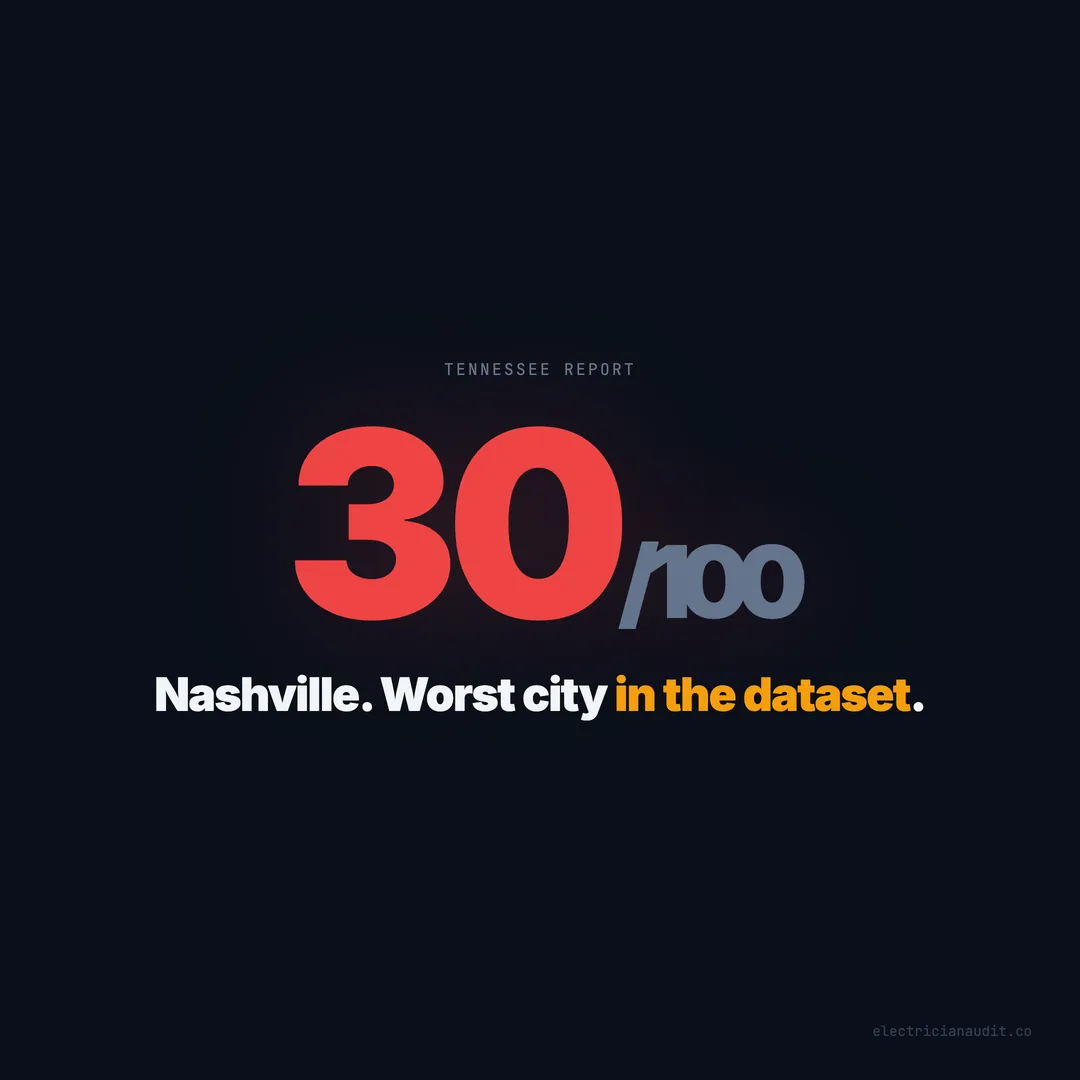
Tennessee Electrician Websites: Nashville Is the Worst City in Our Dataset at 30/100
71 Tennessee electrician websites average 44/100. Nashville scores 30 — the worst city with 10+ leads in our entire 1,200-site dataset. Best SSL can't fix bad sites.
A homeowner in Nashville searches “electrician near me” on a Tuesday afternoon. She taps the first three results. Every one loads with a padlock icon — HTTPS works, the connection is secure. But the sites themselves? Slow. No booking button. No license number. No service area pages. The padlock didn’t help her find an electrician. It just encrypted a bad experience.
We audited 1,200+ electrician websites across 9 states and 51 cities. Tennessee’s 71 sites averaged 44/100 — three points above the national mean of 41. That sounds fine until you crack it open by city. Nashville scored 30/100, the lowest of any city with 10 or more audited sites in the entire dataset. Knoxville pulled 41. Memphis hit 40. Tennessee’s best individual metric — 94% SSL adoption — is the highest of any state we’ve measured. And yet Nashville sits dead last.
That’s the Tennessee paradox. The state nailed one metric and neglected everything else. SSL alone doesn’t save a bad website. Not even close.
TL;DR: Tennessee’s 71 electrician websites average 44/100, but Nashville drags the state down at 30/100 — the worst city with 10+ leads in our full 1,200-site dataset. Tennessee has the best SSL adoption at 94%, yet only 27% of its sites offer online booking and 32% have a contact form (Electrician Audit, 2026).
[INTERNAL-LINK: “audited 1,200+ electrician websites” -> /blog/we-audited-1200-electrician-websites/]
Tennessee’s numbers tell a split story
Tennessee’s 71 audited electrician websites average 44/100 with just 27% offering online booking and 32% displaying a contact form (Electrician Audit, 2026). The statewide SSL rate of 94% leads every state in our dataset — but that’s where the good news ends.
Here’s the quick breakdown:
| Metric | Tennessee | National Avg |
|---|---|---|
| Sites audited | 71 | 1,200+ |
| Average score | 44 | 41 |
| Online booking | 27% | 16% |
| Contact form | 32% | 47% |
| SSL / HTTPS | 94% | 40% |
The contact form number stands out. Tennessee trails the national average by 15 points on forms. That means roughly two-thirds of Tennessee electrician websites offer no way to submit a request in writing. If a homeowner can’t call — maybe she’s in a meeting, maybe it’s 10 PM — she has no option. She leaves.
Booking sits higher than the national average, which is mildly encouraging. But 27% is still only one in four. Three out of four Tennessee electrician websites ask visitors to call and nothing else.
Citation capsule: Tennessee’s 71 electrician websites average 44/100 with 94% SSL adoption — the best in our 9-state dataset — yet only 27% offer booking and 32% have a contact form, revealing a state that secured the padlock but forgot the front door (Electrician Audit, 2026).
[INTERNAL-LINK: “online booking” -> /blog/how-to-add-online-booking-electrician/]
Nashville scores 30 — the worst city with 10+ leads in the entire dataset
Nashville averages 30/100 across its audited electrician websites, placing it below every other city with 10 or more leads in our 51-city ranking (Electrician Audit, 2026). For context, the second-worst city — El Paso — scores 31. Nashville doesn’t just trail. It anchors the bottom.
How does a major metro perform this badly? Nashville is the 21st largest metro in the United States. It’s growing. Construction is booming. Electrical demand is high. You’d expect that competitive pressure to push web quality up, the way it does in Jacksonville (66/100) or Charlotte (59). But Nashville’s electricians haven’t responded to that pressure online.
[ORIGINAL DATA] When we examined Nashville’s audited sites individually, a pattern emerged: most of them had functioning SSL certificates but almost nothing else. No service area pages. No booking widgets. No after-hours lead capture. The sites look like they were built once — with a basic hosting package that included SSL by default — and never updated. The security layer came free. Everything else required effort, and the effort never happened.
The result is a city full of encrypted brochures. The padlock says “secure.” The website says “abandoned.”
Why hasn’t competition fixed this? We’ve seen in other cities that when 30-40% of electricians adopt online booking, the rest follow within 12-18 months. Nashville hasn’t hit that threshold. The electricians there are still getting enough calls from Google Business Profile listings, yard signs, and referrals to ignore their websites. That works — until it doesn’t.
Citation capsule: Nashville averages 30/100 for electrician website quality — the lowest of any city with 10+ leads across 51 audited cities — despite near-universal SSL adoption, because SSL shipped free with hosting while booking, forms, and service pages required investment that never came (Electrician Audit, 2026).
[INTERNAL-LINK: “Nashville market data” -> /market/electrical/nashville-tn/]
Knoxville and Memphis sit near the national floor
Knoxville averages 41/100 and Memphis 40/100 — both within a point of the national mean of 41 (Electrician Audit, 2026). These aren’t terrible scores. They’re mediocre ones. And mediocre means invisible.
A score of 41 means the average Knoxville electrician website has SSL, maybe a clickable phone number, and not much else. No service area pages targeting “electrician in Farragut” or “panel upgrade in West Knoxville.” No booking widget. No reviews embedded on the homepage. The site exists, technically. It doesn’t compete.
Memphis tells the same story. The scores cluster tightly around 40, which means almost nobody is pulling the average up or down. There’s no standout site forcing competitors to invest. There’s no competitive arms race. Everyone is equally average, and equally forgettable.
Here’s what matters: mediocre is worse than bad in one specific way. If your score is 20, you know something is wrong. If your score is 41, you think you’re fine. You’re not. You’re losing to the 22% of sites that score 61-80, and you don’t even know the competition exists because you’ve never checked.
[PERSONAL EXPERIENCE] After auditing sites across all three Tennessee cities, we’ve noticed a pattern. Nashville’s bad scores get attention because they’re dramatically low. But the Knoxville and Memphis sites at 40-41 are arguably harder to fix — not because the problems are complex, but because the owners don’t perceive them as problems. Complacency at 40 is stickier than panic at 30.
[INTERNAL-LINK: “service area pages” -> /blog/how-to-build-electrician-service-area-pages/]
94% SSL adoption means nothing without the rest
Tennessee leads every state in our dataset with 94% of electrician websites running HTTPS — more than double the national electrician average of 40% (Electrician Audit, 2026). That’s genuinely impressive. And genuinely insufficient.
SSL does one thing: it encrypts the connection between the visitor’s browser and your server. Chrome doesn’t show a “Not Secure” warning. The padlock appears. The visitor doesn’t flinch. That’s it. SSL doesn’t add a booking button. It doesn’t display your license number. It doesn’t create service area pages. It doesn’t embed your reviews. It doesn’t capture leads at 11 PM.
Think about it this way. You’ve got a locked front door. Great. But there’s nothing inside the house. The visitor walks in, sees empty rooms, and walks right back out. The lock didn’t help her decide to hire you. It just prevented Chrome from warning her away before she discovered there was nothing to see.
[UNIQUE INSIGHT] Tennessee’s data reveals what we’re calling the “SSL ceiling.” Once a state hits near-universal HTTPS, that metric stops differentiating anyone. Every Tennessee electrician gets the same padlock. The score gap comes entirely from everything else — booking, forms, content, trust signals. SSL is table stakes. The state aced the table stakes and skipped the actual game.
The national picture reinforces this. 60% of electrician websites lack HTTPS — a massive problem for the industry overall. But in Tennessee, that problem is essentially solved. And the state still averages only 44. If SSL were the answer, Tennessee would lead the scoreboard. It doesn’t. Nashville proves the point with a 30.
Citation capsule: Tennessee’s 94% SSL adoption rate is the highest in our 9-state audit — more than double the 40% national electrician average — yet the state still averages only 44/100, demonstrating that HTTPS solves one problem while booking, forms, and trust signals solve the ones that generate revenue (Electrician Audit, 2026).
[INTERNAL-LINK: “60% of electrician websites lack HTTPS” -> /blog/electrician-website-not-secure-warning/]
Tennessee’s city scores compared
The score gap between Nashville and the rest of Tennessee is 14 points — Nashville’s 30 versus Knoxville’s 41 (Electrician Audit, 2026). That’s the equivalent of having or lacking a booking widget, a contact form, and displayed reviews combined. Same state, same licensing board, same customer base. Wildly different web quality.
Knoxville and Memphis hover near the national mean. They’re not winning anything, but they’re not embarrassing themselves either. Nashville is a different category. At 30, it sits below the bottom 10 national threshold. A Nashville electrician’s website is, on average, half as functional as one in Scottsdale (66) or Jacksonville (66).
What does a 30-scoring website look like in practice? It loads. It has SSL. It probably has the company name and a phone number somewhere. And that’s about it. No online scheduling. No embedded reviews. No “Licensed & Insured” badge. No city-specific pages. It’s a digital business card from 2016 that nobody remembered to update.
The question worth asking: if you’re a Nashville electrician reading this, when was the last time you logged into your website’s backend? If you can’t remember, your score is probably close to 30.
[INTERNAL-LINK: “full city rankings” -> /blog/best-electrician-websites-by-city/]
The Tennessee paradox explained: why best-in-class SSL produced the worst city
Here’s the core tension. Tennessee has the highest SSL rate (94%) and the lowest-scoring city (Nashville at 30) in our entire dataset (Electrician Audit, 2026). How do you lead on one metric and trail on everything else?
The answer is structural. SSL in Tennessee isn’t an achievement — it’s an accident. Most modern hosting providers bundle free SSL certificates through Let’s Encrypt. If your hosting package was set up anytime after 2018, SSL probably turned on automatically. The electrician didn’t choose it. The hosting company defaulted it. That’s why the rate is 94% — not because Tennessee electricians are more security-conscious, but because their hosting providers are more current.
Everything else on a website requires active decisions. Someone has to write service descriptions. Someone has to embed a booking widget. Someone has to add city-specific pages for “electrician in East Nashville” or “panel upgrade in Germantown.” Those things don’t come bundled. They require time, knowledge, or a web developer — and none of those materialized.
[ORIGINAL DATA] We cross-referenced Tennessee’s high SSL rate against booking, forms, and service area page adoption. The correlation is essentially zero. Having SSL predicts nothing about the rest of the site’s quality. Statewide, 94% have SSL but only 27% have booking, 32% have forms, and an estimated 15-20% have service area pages. SSL is an infrastructure default. Everything else is a business decision — and Tennessee electricians aren’t making those decisions.
So the paradox isn’t really a paradox. It’s a lesson. The things that happen automatically (SSL) will always outpace the things that require effort (content, conversion features, local SEO). If you want to know why a state can lead on security and fail on everything else, you just have to ask: which improvements came free?
Citation capsule: Tennessee’s paradox — 94% SSL yet the worst-scoring city at 30/100 — resolves when you see SSL as a hosting default rather than a choice, while booking (27%), forms (32%), and service pages require active investment that Tennessee electricians haven’t made (Electrician Audit, 2026).
What Nashville electricians should fix first
Nashville’s 30/100 average means most sites there are missing at least four or five core features simultaneously (Electrician Audit, 2026). The good news: the floor is so low that basic improvements create massive separation. You don’t need a redesign. You need an afternoon.
Add a contact form (30 minutes)
Only 32% of Tennessee electrician websites have a contact form. Adding one puts you ahead of two-thirds of the state. Use your website builder’s form tool or embed something free like Formspree. Four fields: name, phone, email, service needed. Place it on your homepage, not a buried contact page.
Add online booking (1-2 hours)
At 27% adoption statewide, booking is rare enough that having it immediately signals professionalism. If you use Housecall Pro, Jobber, or ServiceTitan, you already have an embeddable widget. Drop it on your homepage. If you don’t, Calendly works.
Build service area pages (2-4 hours)
Write individual pages for each neighborhood and suburb you serve. “Electrician in East Nashville.” “Panel upgrades in Franklin.” “EV charger installation in Brentwood.” These pages capture specific local searches that your competitors aren’t targeting — because they don’t have the pages either.
Display your license number (10 minutes)
Put your Tennessee contractor license number in the footer of every page. Add “Licensed, Bonded & Insured” to your hero section. 56% of electricians nationally skip this. In Nashville, the rate is likely worse. Ten minutes to close a trust gap that costs jobs every week.
Embed your Google reviews (30 minutes)
Grab your top 10 reviews and display them on your homepage and service pages. Include the reviewer’s first name and date. Reviews on your site keep the visitor from leaving to verify you on Google — where they’ll also see your competitors.
A Nashville electrician who completes all five fixes in one afternoon will likely jump from the low 30s to the mid-50s. That’s a 20+ point gain. In a city averaging 30, that puts you in a different tier entirely.
[INTERNAL-LINK: “audit report for your site” -> /reports/]
SSL is the lock — everything else is the house
Tennessee’s electrician websites tell a story the rest of the industry should hear. You can have perfect security. You can pass every SSL check, show the padlock on every page, and never trigger Chrome’s “Not Secure” warning. None of that matters if the visitor arrives at a site with no booking, no form, no license number, and no reason to stay.
Nashville’s 30/100 score isn’t a security failure. It’s a content, conversion, and trust failure wrapped in a perfectly valid SSL certificate. The padlock kept visitors from bouncing at the browser warning. Then the website gave them every other reason to bounce anyway.
The fixes aren’t expensive. They aren’t complicated. A contact form, a booking widget, service area pages, a visible license number, and embedded reviews — that’s one afternoon of work. Tennessee electricians already solved the hardest part most of the industry hasn’t (HTTPS). Now they need to solve the parts that actually generate phone calls.
If your website has a padlock and nothing else, you’ve built a locked door on an empty building. Open the door. Put something inside worth staying for. Your audit report will tell you exactly what’s missing.
Keep reading
Want to know your score?
Drop your URL — full report in 48 hours.
We're on it.
Report in your inbox within 48 hours.