Only 1.9% of Electrician Websites Score Above 80 — We Audited 1,200 to Find Out Why
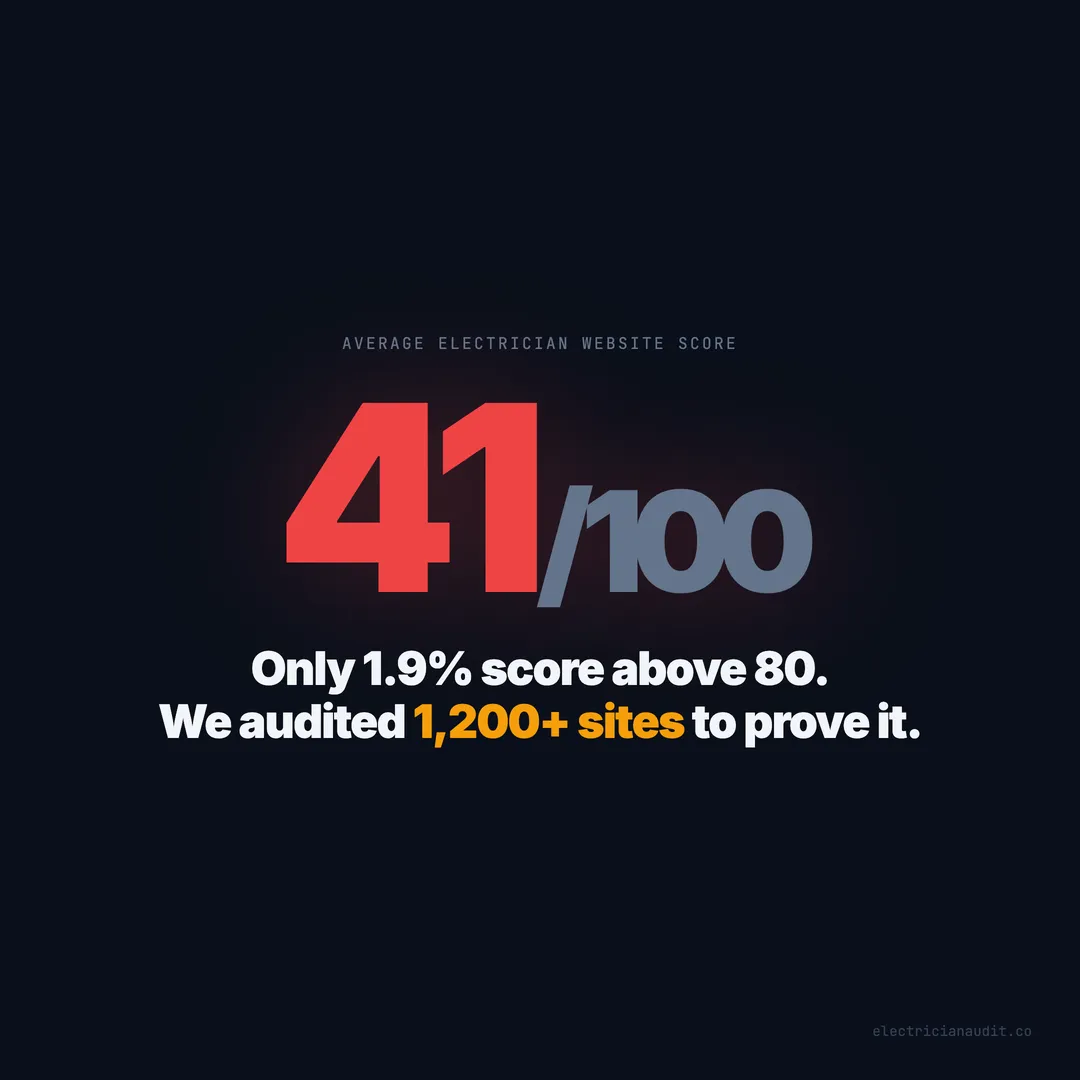
We audited 1,200+ electrician websites across 9 states and 51 cities. Average score: 41/100. Only 1.9% clear 80. Here's what the top sites do differently.
It’s Tuesday morning. A homeowner in Charlotte types “electrician near me” into Google. Ten results load. She taps the first three, spends about eight seconds on each, and picks the one with online booking and a license number in the footer. The other two never stood a chance — and they’ll never know why.
We built a crawler, pointed it at 1,200+ electrician websites across 9 states and 51 cities, and scored every single one. The average site pulled a 41 out of 100. Out of 1,390 sites we touched, only 26 cleared a score of 80. That’s 1.9%.
The industry isn’t struggling at the top. It’s struggling at the floor. Most electrician websites fail on basics that haven’t changed in a decade — no booking, no HTTPS, no service area pages, no visible license number. The sites that do these things score 15 to 24 points higher than the ones that don’t. And the gap between “has these features” and “doesn’t” translates directly into lost calls, lost jobs, and lost revenue.
This is the full breakdown. Every number comes from our audit data. Nothing borrowed, nothing estimated.
Where 1,200+ Electrician Websites Actually Land
Most electricians assume their website is “fine.” The data says otherwise. Nearly half of all sites we audited — 424 out of 1,390 — scored between 21 and 40. Another 243 scored below 20. That means 48% of electrician websites can’t clear a score of 40.
Here’s the full distribution:
| Score Range | Sites | Share |
|---|---|---|
| 0–20 | 243 | 17.5% |
| 21–40 | 424 | 30.5% |
| 41–60 | 375 | 27.0% |
| 61–80 | 310 | 22.3% |
| 81–100 | 26 | 1.9% |
The shape tells the story. A massive bulge in the 21–60 range, a respectable tail from 61–80, and then a cliff. The 81–100 bracket is almost empty. If you score a 65, you’re already in the top quarter of the industry. That’s not a high bar — that’s a broken one.
The 41-Point Average Isn’t Random
A 41/100 average doesn’t mean most sites are mediocre. It means most sites are missing entire categories of functionality. They don’t score low on booking — they don’t have booking at all. They don’t score low on schema — 95% have zero schema markup. The score isn’t dragged down by weak execution. It’s dragged down by absence.
The Six Features That Separate Winners from Everyone Else
Six features account for most of the scoring gap between top-performing electrician websites and the rest. Every one of these represents a conversion failure that costs real money. The biggest gap — 24 points — belongs to a feature most electricians don’t even think about: whether they’re running ads.
Here’s what the data shows:
| Feature | Has It | Lacks It | Gap |
|---|---|---|---|
| Running Google Ads | 64 | 40 | +24 pts |
| Click-to-call button | 52 | 32 | +20 pts |
| Service area pages | 59 | 41 | +18 pts |
| Online booking | 55 | 39 | +16 pts |
| After-hours capture | 57 | 41 | +16 pts |
| License displayed | 54 | 41 | +13 pts |
None of these are exotic features. Click-to-call is a phone number with tel: in the href. Service area pages are static pages with city names. Online booking is an embedded widget or a Calendly link. Yet 84% of electrician websites have no booking, 70% have no service area pages, and 53% don’t even have a contact form.
Why the Ads Gap Is the Biggest
Electricians running Google Ads score 64 on average versus 40 for those who aren’t. That 24-point gap is the largest in our dataset, and it isn’t because ads make your website better. It’s because electricians who invest in ads are more likely to have also invested in their website. They’ve got landing pages. They’ve got call tracking. They’ve got forms that actually work.
The ads aren’t the cause — they’re a proxy for taking the web seriously. If you’re spending $2,000 a month on Google Ads and sending that traffic to a site that scores 35, you’re burning money on ads that can’t convert.
What Every Missing Feature Costs Per Month
Numbers on a chart don’t pay bills. So what does a 20-point score gap actually mean in revenue? We can’t know every market, but we can build conservative estimates from what we’ve observed across 51 cities worth of data.
No click-to-call button. A mobile visitor who can’t tap to call has to copy your number, switch apps, and paste it. Most won’t bother. In a market where an average electrical job runs $300–$500, losing even two calls a week to friction means $2,400–$4,000 per month walking away. The score gap: 20 points.
No online booking. When 84% of your competitors also lack booking, you might think it doesn’t matter. It does. The 16% that have it score 55 versus 39. Homeowners who can’t book online at 10 PM on a Sunday call someone who lets them. Conservatively, that’s 3–5 lost leads per week in competitive markets.
No service area pages. This is the local SEO killer. Google can’t rank you for “electrician in Katy TX” if you don’t have a page that mentions Katy, TX. Sites with service area pages score 59 versus 41. Each missing city page is a search you’re invisible for. In metro areas with 10+ suburbs, that’s dozens of potential entry points gone.
No after-hours capture. Electrical emergencies don’t wait for business hours. A tripped breaker at 11 PM, a flickering outlet at 6 AM — these are high-urgency, high-value calls. Sites with after-hours capture (chatbots, forms with “emergency” routing, answering services) score 57 versus 41. That 16-point gap represents every after-hours lead that called your competitor instead.
No HTTPS. It’s 2026 and 60% of electrician websites still don’t redirect HTTP to HTTPS. Chrome has flagged non-HTTPS sites as “Not Secure” since 2018. Every visitor sees that warning. The trust erosion alone costs conversions — and Google confirmed HTTPS as a ranking signal over a decade ago.
No license number. Here’s one that surprises people. Displaying a license number — a basic trust signal — correlates with a 13-point score boost (54 vs 41). Yet 56% of electrician websites don’t show one. In states where licensing is mandatory, this isn’t just a conversion issue. It’s a compliance gap.
Electricians Running Ads vs. Everyone Else
The ads divide tells a story about investment mindset, not ad spend. Only 24% of electrician websites in our dataset showed signs of running Google Ads (active tracking pixels, UTM parameters, or dedicated landing pages). But that 24% outscored the other 76% by a full 24 points.
Here’s what the ads group gets right more often:
- Dedicated landing pages with a single CTA
- Call tracking numbers so they know what’s working
- Forms above the fold — not buried on a contact page
- Faster load times because ad platforms penalize slow pages
- Mobile optimization since most ad traffic is mobile
The non-ads group isn’t just missing ads. They’re missing the entire infrastructure that ads demand. If you’ve ever wondered why your phone isn’t ringing despite “having a website,” look at the gap: 64 versus 40. That isn’t a scoring quirk. That’s two different eras of web presence.
Reviews Amplify the Gap
Review count tells a similar story. Electricians with 100+ Google reviews average a score of 61. Those with fewer than 20 average 30. That’s a 31-point canyon.
It’s not that reviews directly improve your website score. It’s that the kind of electrician who accumulates 100+ reviews is also the kind who invests in follow-up systems, branded emails, and review request automation. The review count is a signal of operational maturity — and operational maturity shows up in the website.
State-by-State Scores Reveal Regional Gaps
Geography shapes web quality more than most electricians realize. North Carolina leads our dataset with an average score of 52, while Louisiana trails at 39. That 13-point spread isn’t random — it tracks with market competitiveness, population density, and local adoption of digital tools.
| State | Sites Audited | Avg Score | Has Booking | Has Form | Has SSL |
|---|---|---|---|---|---|
| NC | 93 | 52 | 32% | 32% | 67% |
| GA | 93 | 49 | 12% | 13% | 34% |
| FL | 345 | 47 | 30% | 29% | 71% |
| AZ | 104 | 46 | 36% | 36% | 89% |
| TX | 463 | 45 | 32% | 32% | 78% |
| TN | 71 | 44 | 27% | 32% | 94% |
| LA | 51 | 39 | 29% | 31% | 78% |
A few things stand out. Georgia has the worst form adoption at 13% and the worst SSL at 34% — yet scores 49, propped up by other signals. Arizona leads in SSL adoption at 89% and booking at 36%. Tennessee has the highest SSL rate at 94% but still scores only 44 because so many other basics are missing.
City-Level Leaders and Laggards
The city data is where things get sharp. Scottsdale and Jacksonville both average 66, nearly double the national average. Meanwhile, Nashville sits at 30 and El Paso at 31. The full city leaderboard is available on our city market pages.
Top 5 cities:
- Scottsdale, AZ — 66
- Jacksonville, FL — 66
- Katy, TX — 61
- Charlotte, NC — 59
- Chandler, AZ — 59
Bottom 5 cities:
- Nashville, TN — 30
- El Paso, TX — 31
- Denton, TX — 31
- Sarasota, FL — 32
- Cape Coral, FL — 33
What do Scottsdale and Jacksonville have in common? Affluent homeowner bases, high competition among service providers, and a higher percentage of electricians running ads. Nashville, despite being a booming market, has one of the youngest and most fragmented electrician landscapes — lots of new operators with template websites.
What the Top 1.9% Do Differently
Those 26 sites that scored above 80 aren’t doing anything exotic. They’re just doing everything. When we looked at what the top 1.9% share, the pattern was obvious — and frustrating, because none of it is hard.
Every site in the top 1.9% has all six of these:
- HTTPS with proper redirect — no mixed content, no certificate errors
- Click-to-call in the header and footer — persistent, not hidden on a contact page
- Online booking or an intake form above the fold — the visitor doesn’t scroll to take action
- Service area pages for at least 5 cities — dedicated pages, not a list buried in the footer
- License and insurance displayed visibly — usually header or footer
- Schema markup — at minimum LocalBusiness with service area and contact info
That last point is striking. 95% of all electrician websites have zero schema markup. The top 1.9% all have it. Schema doesn’t show up on the page — visitors never see it. But search engines read it, and AI systems extract it. It’s a competitive moat that costs nothing to implement and almost nobody bothers.
The Compounding Effect
Each feature on its own adds 13–24 points to the average score. But the top sites don’t just have one or two. They have all of them, and the effect compounds. A site with booking, click-to-call, service area pages, and schema doesn’t score 55 — it scores 80+. The whole is greater than the sum because each feature reinforces the others.
Service area pages bring in local traffic. Click-to-call and booking convert that traffic. After-hours capture catches the overflow. Schema helps search engines and AI assistants surface the site in the first place. Remove any one link and the chain weakens. Have them all and you’re in the top 26 out of 1,390.
The Hidden Crisis: 95% Have No Schema, No Alt Tags, No Meta
The visible failures — missing booking, missing forms — are bad enough. But the invisible ones might be worse. These are the things a visitor never sees but that Google’s crawler, AI citation systems, and accessibility tools depend on entirely.
- 95% of electrician websites have no schema markup — Google can’t parse your business type, service area, or contact info in structured format
- 95% have missing or weak meta descriptions — your search snippet is auto-generated garbage
- 95% have no image alt tags — screen readers can’t describe your work, and Google Image Search ignores you
- 60% don’t have a blog — no content for informational queries, no way to build topical authority
- 39% have no analytics installed — they literally can’t measure what’s working
This is the real crisis. It’s not that electricians have bad websites. It’s that they can’t see how bad they are. Without analytics, you don’t know your bounce rate. Without meta descriptions, you can’t control your first impression. Without schema, AI assistants skip you entirely when recommending local electricians.
Could an electrician in your city be losing calls right now because ChatGPT doesn’t know they exist? With 95% having no schema, the odds are yes.
How We Scored 1,200+ Sites (Our Methodology)
Transparency matters. Here’s exactly how we built the audit and what we measured. We didn’t use a third-party scoring tool. We built our own crawler and scoring engine, tuned specifically for local service businesses.
What we crawled:
- 1,390 electrician websites across TX, FL, AZ, GA, NC, TN, LA, SC, and NM
- 1,259 received deep audits (full page analysis, not just homepage checks)
- Data collected between January and March 2026
What we scored:
Our scoring engine checks 40+ signals grouped into five categories:
- Trust signals — HTTPS, license number, insurance mentions, reviews, BBB
- Conversion elements — click-to-call, booking, forms, CTAs, after-hours capture
- Local SEO — service area pages, Google Business Profile link, city targeting, schema
- Content quality — blog presence, word count, meta descriptions, alt tags, H1 structure
- Technical health — mobile responsiveness, load speed, SSL config, canonical tags
Each category contributes to a 0–100 composite score. The full methodology is on our market research page, and every individual site’s breakdown is available on its report page.
See Where Your Website Stands
The average electrician website scores 41 out of 100. The top 1.9% score 80+. Most fall somewhere in between — missing two or three features that would move them from invisible to competitive.
You don’t need to guess where you land. We’ve published individual audit reports for hundreds of electrician websites across all 51 cities in our dataset. Find your city, find your business, and see the exact score breakdown — what you’re doing right, what you’re missing, and what it’s likely costing you.
If your site isn’t in the dataset yet, request a free audit from the homepage. It takes us about 48 hours, and you’ll get the same full breakdown: trust signals, conversion elements, local SEO, content quality, and technical health.
The bar is on the floor. Almost nobody clears it. That’s not a discouragement — it’s the biggest opening in the industry.
Keep Reading
Want to know your score?
Drop your URL — full report in 48 hours.
We're on it.
Report in your inbox within 48 hours.